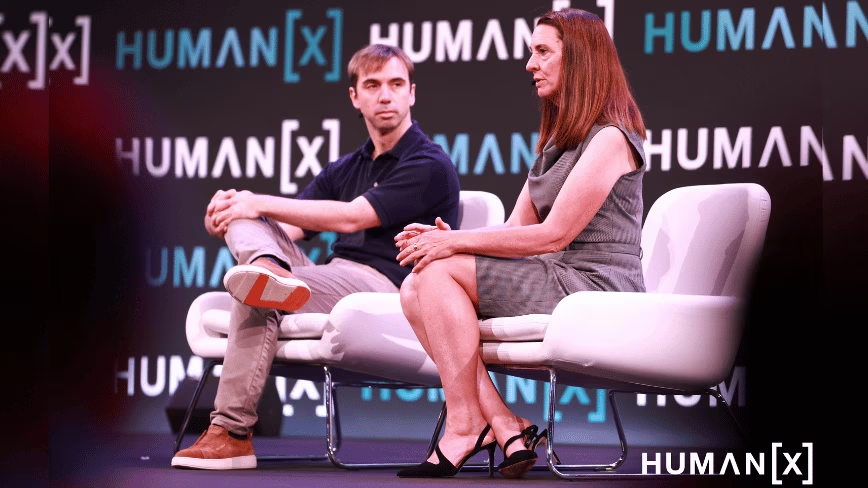
Booking.com’s James Waters (left) and Diageo’s Susan Jones at HumanX in Amsterdam, 23 September 2026.
 Credit: Sam Pinto / HumanX
“AI isn’t going to take your job. Somebody who embraces it and learns faster than you might. AI is not going to take away your customers. A company that uses it more smartly than you do might,” Booking.com chief business officer James Waters said.
Booking.com built AI orchestrations and other tools it now wishes it had never built, Waters said. Frontier model makers later shipped the same capabilities, and with hindsight he called it regrettable work.
Waters spoke on Wednesday at HumanX in Amsterdam with Susan Jones, Diageo’s chief digital officer. Bloomberg’s Amsterdam bureau chief, Dasha Afanasieva, moderated the panel on the cost of deploying AI at scale.
Models and agents moved faster than anyone expected two to three years ago, Waters said. Today Booking.com would buy those tools off the shelf and focus on its customer problems and proprietary data.
“AI isn’t going to take your job. Somebody who embraces it and learns faster than you might. AI is not going to take away your customers. A company that uses it more smartly than you do might,” Waters said.
89% want AI, 6% trust it
In research Booking.com carried out, 89% of people said they would like to use AI to research travel, Waters said. Only 6% said they trust it to make decisions.
LLMs are the fastest-growing travel research tools, but people do not use them to book yet, he said. Travel is expensive in time, money and emotion, so he expects it to be among the last categories to move to agentic commerce. Two hotel groups that moved into ChatGPT in July did not let users pay there. In August, Google Maps’ Ask Maps agent began offering to book your hotel.
Waters compared the risk to self-driving cars. Each crash takes them all off the road, while people crash more often and nobody takes people off the road. For Booking.com, the crash would be irrelevant content or wrong prices.
The company builds its AI products up from specific, high-intent searches toward more aspirational discovery, he said. It could put an LLM on its homepage tomorrow, but connecting it is the hard part.
A pencil, not a cost cut
Diageo’s most scaled tool is a suite it calls the virtual content studio, used in every country for every brand, Jones said. Global brand teams create the content, and regional versions of the studio adapt it for local markets. Afanasieva said Diageo has more than 200 brands.
Brand teams feared the tools would bring more content rather than better content, Jones said. Diageo positions its content tool, Pencil, as a springboard for creativity, not a way to produce more for less. Regulatory guardrails are built into the tool, and a marketer makes every final call.
“It’s a very apt name because it’s like giving somebody a pencil to be creative with,” Jones said.
Two sprints off the backlog
For Waters, the change is about human behavior. Staff ask what is in it for them, and they follow the path of least resistance, so a new tool has to be easier than the old one. Booking.com also told its product and tech teams to stop work on their backlogs for two sprints and explore how AI could change their work.
A central team of experts owns the tools, knowledge base, training and support, Waters said. One of its KPIs is the share of generative AI use cases delivered without its help. Too high means the core team is not innovating, and too low means the rest of the business has not learned.
Diageo puts the tools in the hands of the people doing the jobs, Jones said. A cross-functional marketing team reviews regulatory and ethical issues. It also sees every agent and tool in development, so Diageo can find the promising ones and scale them. Lovable co-founder Fabian Hedin told HumanX that staff at large companies often find its tool themselves.
No ROI number, and no sleep lost
Nobody has a precise ROI figure for AI, and Booking.com does not need one, Waters said. As a fully digital business, it can measure exactly what a product change cost and earned. In other areas, it sets a spend it is comfortable with. Counting the share of code written by AI makes no sense, he said, because lines of code and problems solved are not directly related.
He said geopolitical instability affects travel in specific places and times, while the AI transformation will only go forward. Booking.com tracks its AI spending but is not losing sleep over it, he said.
Jones said Diageo’s early experiments added AI on top of existing processes and did not work. Companies have to fix their processes and data first, she said, and then apply AI.
“It’s not really about the technology at all. It’s about the people and the processes,” Jones said.
Get the TNW newsletter
Get the most important tech news in your inbox each week.


