TL;DR
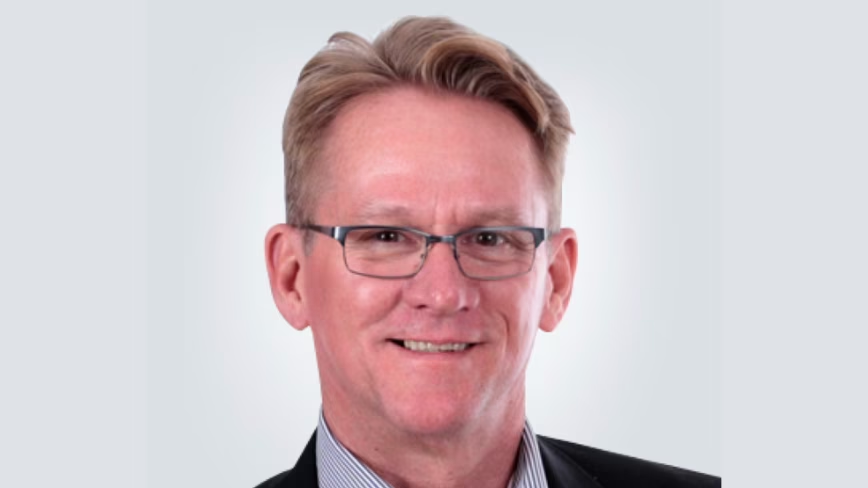
Technology advisor Monty McCoy argues that the most important question about AI is not whether machines will take jobs but what people will do with the time that opens up. He warns that removing the “whirlwind” of routine work without helping people develop new sources of meaning could create a vacuum filled by distraction, outrage, and division rather than creativity and connection.
When I had back surgery, I assumed recovery would be linear.
I thought each week would bring a little less pain, a little more mobility, and another step toward normal. Then I hit a setback. I had assumed I was further along than I actually was.
That experience has stayed with me because I think we are making a similar assumption about artificial intelligence.
We talk about the transition to an automated world as though it will follow a predictable path. AI capabilities will improve. Companies will adopt them. Autonomous systems will become more common. Workers will adjust. Eventually, much of the routine work that fills our days will be handled by machines.
I do not think it will happen that neatly.
The transition will be uneven. Some technologies will advance faster than expected. Others will stall. Industries will respond differently. Physical AI will introduce another layer of unpredictability as machines move beyond screens and into roads, factories, warehouses, homes, and public spaces.
There will be breakthroughs, disappointments, resistance, and surprises.
The question that interests me most, however, is what happens to us when the technology actually works.
For most people, work provides more than a paycheck. It gives the day a shape. It creates obligations, deadlines, and reasons to get up in the morning. Much of what occupies our working lives is what I call the whirlwind: the emails, meetings, administrative tasks, repetitive processes, and constant demands that consume our attention.
We complain about the whirlwind, yet we have also built our identities around it.
So what happens when it starts to disappear?
When the machines can handle the routine tasks, when software agents can manage processes that once required entire teams, when autonomous systems can perform physical work that once demanded human labor, what fills the space left behind?
That is a deeply personal question before it becomes an economic or political one.
When the whirlwind stops, who do you become?
I do not think most people will automatically use that freedom to discover some grand new purpose. We like to imagine that if technology gave us more time, we would spend it learning, creating, traveling, volunteering, or deepening our relationships.
Maybe some of us would.
Many others might simply fill the space with more noise.
We already live in an economy built around capturing attention. Our phones can fill any empty moment. Social platforms can provide an endless stream of content. Entertainment is available whenever we want it. If automation removes more of the structures that currently organize our days, there is no guarantee that people will use the resulting freedom well.
That possibility concerns me more than the idea of robots taking jobs.
A society with more free time could become more creative, more connected and more human. It could also become more distracted, fragmented and restless. The technology itself will not determine which direction we take.
Our choices will.
This is why I have become increasingly interested in the idea of ownership.
As AI becomes embedded in everyday life, people will have to think more deliberately about what they control. That includes their data, certainly, but it also includes their time, attention, skills, and sense of purpose.
We have become accustomed to handing pieces of our lives to systems because doing so is convenient. We accept the terms, click the button, and move on. The scale of that exchange is about to change dramatically.
The more capable our systems become, the more important individual agency becomes.
I am genuinely excited about that future.
I can imagine an older person retaining independence because autonomous transportation gives them mobility long after driving becomes difficult. I can imagine technology removing some of the physical limitations that have historically determined what people can do as they age. I can imagine people spending less of their lives on repetitive tasks and more of them pursuing work and experiences that require judgment, curiosity, creativity, and human connection.
That is an extraordinary opportunity.
But opportunity does not automatically become fulfillment.
If we remove the structures that have occupied people’s time without helping them develop new sources of meaning, we could create a vacuum. And vacuums tend to get filled.
They can be filled by entertainment. By outrage. By endless consumption. By tribalism. By political and social division. They can also become a source of anxiety between people who benefit from automation and people who believe they have been pushed aside by it.
I am not predicting that outcome. I am arguing that we should take it seriously while we still have time to shape what comes next.
The mistake would be to assume that technological progress and human progress are the same thing.
They are related, but they are not automatic.
The coming transition will require us to think about questions that technology cannot answer for us. What is a good life when efficiency is no longer the primary constraint? What gives a person meaning when employment occupies less of their identity? What happens to communities when fewer people share the same daily routines? How do we make sure greater technological capability produces greater human agency?
I do not have a simple answer to those questions.
I think that is precisely why we need to start asking them.
My recovery taught me that progress rarely follows the schedule we imagine for it. The body has its own timeline. So will this technological transition.
There will be moments when AI advances faster than society expects, followed by moments when adoption slows, or unexpected consequences force us to reconsider the path.
We should embrace the possibilities without assuming the outcome is predetermined.
The future will not simply happen to us. We will have a role in deciding what fills the space when the whirlwind stops.
And we should start claiming the controls before the systems do.