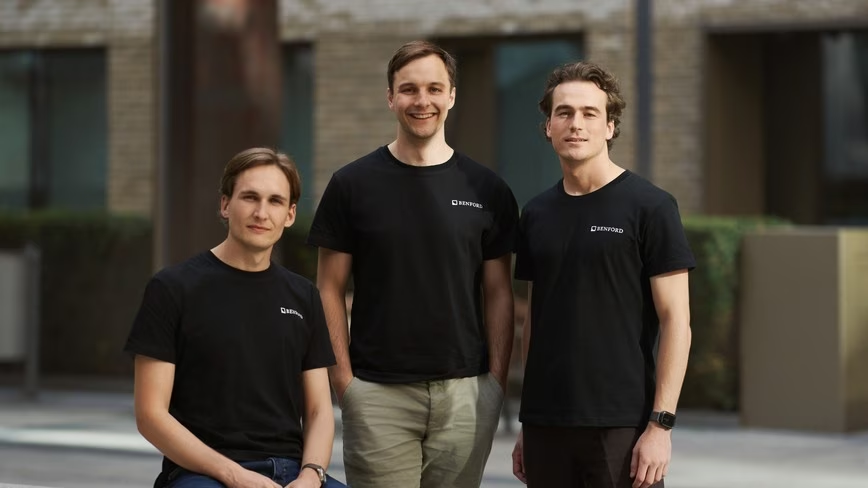
Benford co-founders Mads Bogen Øye, Andreas Rystad, and Thibault Mallion (from left).
 Credit: Benford
For two decades, the standard way to modernize auditing has been to build software and sell it to auditors. Benford has decided to skip the middleman and become the auditor.
Today, the Oslo- and London-based company Benford announced it has raised €5 million in pre-seed funding to build a tech-focused financial audit firm.
The company aims to handle the entire statutory audit process, from a client’s systems to the signed opinion. firstminute capital led the funding round, with Global Founders Capital and Sondo also backing the company.
The list of angel investors includes well-known names from European finance software, such as Peter ter Maaten of HSO, Arthur Waller and Quentin de Metz of Pennylane, Alexandre Prot of Qonto, and the Spandow family from Amesto.
Benford did not share the company’s valuation, but it is already a registered audit firm in Norway and says its proprietary engine, AuditOS, is currently running client audits.
The founders are Mads Bogen Øye, Thibault Mallion, and Andreas Rystad, who have worked at Palantir, Goldman Sachs, and One Peak.
Benford sees an opportunity in the small- and mid-sized segment of the European audit market.
The company says large firms are pulling back, consolidators are buying practices faster than they can modernize them, and local firms lack the resources to update their technology.
“Every attempt to modernise audit has been aimed at the auditor’s desk. The firm around it was left untouched.” explains Mads Bogen Øye, co-founder and co-CEO of Benford.
The profession is also losing more people to retirement than it is recruiting. Meanwhile, audit fees continue to rise, as shown by UK audit fee data.
“Audit is one of the few services where the customer experience has got worse every year while the bill has gone up,” Mallion said in a statement.
Benford holds the license, builds the platform, and employs qualified auditors who manage each engagement, handle exceptions, and sign the opinions.
AuditOS connects to a client’s ERP, subledgers, invoices, bank accounts, and other systems to create what the company calls a single “audit brain” that improves with each engagement.
Every test is run through this system, and all inputs are logged, traced to their source, and assigned to a specific auditor. Work from one year carries over to the next, so each new audit starts where the last one ended.
Benford also addresses a hidden cost: the time finance teams spend answering auditors’ questions.
Follow-up requests are managed in a single shared interface instead of scattered across email inboxes. This detail is likely more important to finance directors than any mention of AI.
Michael Stothard, a partner at Firstminute Capital, said in a statement that the Big Four firms are leaving the mid-market just as new technology is making it possible to serve these clients better.
“For twenty years, innovation in audit has meant selling tools to auditors, and most audits are still done the old way. Audit is a huge, structurally overlooked market that nobody has tried to rebuild from first principles,” said Michael Stothard, partner at firstminute capital.
Get the TNW newsletter
Get the most important tech news in your inbox each week.


