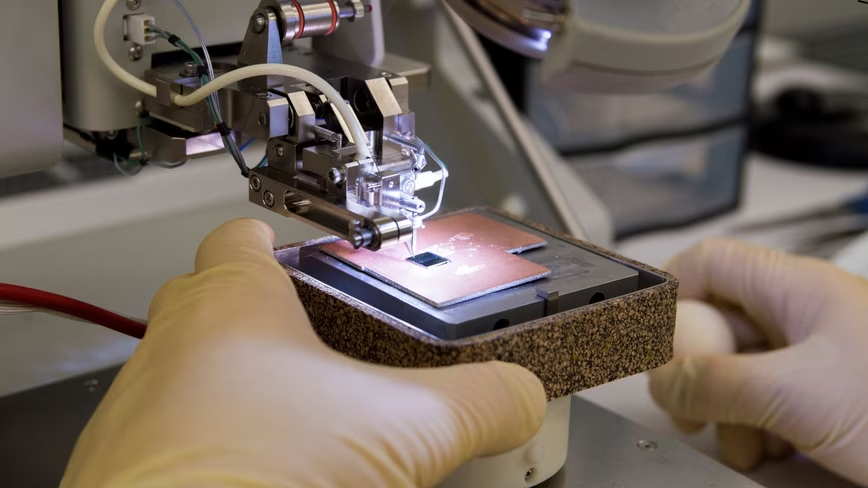
 Credit: © Aaron Hawkins / Getty Images via Canva.com
Belgian prosecutors have held a 52-year-old man in pre-trial detention since 10 May on suspicion of passing chip-making secrets to China. He holds Belgian and Chinese nationality. Police arrested him at Brussels Airport as he was about to board a flight to Beijing, the Federal Prosecutor’s Office said in a statement on Monday. That is four months after the fact.
The man held a senior research position at BelGaN, the gallium nitride chip maker in Oudenaarde that went bankrupt in July 2024. Francophone broadcaster RTBF and the Flemish daily De Standaard broke the story on Monday morning. Reuters, AP, Bloomberg, the Financial Times and the Wall Street Journal followed once prosecutors confirmed it.
Prosecutors are investigating four charges: espionage, participation in a criminal organisation, misuse of company assets, and unlawful disclosure of trade secrets. The man denies them, according to RTBF. Prosecutors are also looking for a second suspect.
What prosecutors say happened
The statement is careful. The investigation “may point to the unlawful transfer abroad of specialised intellectual property and trade secrets relating to the production of gallium nitride chips”, it says. While holding his research post at BelGaN, the suspect was “simultaneously acting as a director of a Chinese company engaged in a similar manufacturing activity”. That company appeared a few months after he joined the Belgian firm. A Chinese investment fund financed it.
Investigators seized data storage devices and communications equipment and are still analysing them. No court has convicted anyone of anything.
Gallium nitride is the material behind fast chargers, electric vehicle power electronics, satellite communications, radar and electronic warfare. It is a small, specialised corner of the chip industry, and Belgium had exactly one company in it.
The company that died
The Oudenaarde site is older than most of the European chip industry. It opened more than 40 years ago as MIETEC and later passed through AMI Semiconductor and ON Semiconductor. It was Belgium’s last industrial chip fab, according to VRT. In February 2022, in financial trouble, a consortium of Chinese investors bought it and renamed it BelGaN. The new chief executive, Alan Zhen Zhou, said he saw an opportunity to build a “GaN valley” in Europe.
A few months after the takeover, a company called Gankool opened in Fujian province to make the same technology, VRT reported. In July 2024, BelGaN went bankrupt. VRT puts the job losses at 440; AP says around 400.
The bankruptcy itself is what triggered the investigation. Belgian authorities were already looking at how the company failed when the espionage line opened up. Investigators suspect the buyers never meant to rescue the firm, only to obtain what it knew, VRT reported.
The second suspect, still at large, is the former chief executive Zhou, according to RTBF and De Standaard. Prosecutors have not named him and TNW has not independently confirmed the identification.
The playbook has a name
Belgium’s State Security Service described this exact pattern in its latest annual report, before the arrest became public. It calls them mirror companies. Chinese investors buy into a Belgian company, research centre or spin-off. They prefer a small one with promising technology and not enough money. They gain access to the technology and set up a mirror company in China to produce it at scale. Then they sell the original on again, at a profit if possible.
The report’s framing is blunt: China knows it still trails Europe and the US in some specific technologies, and closing that gap is its top priority. VRT reports the federal prosecutor counted about 15 espionage cases last year, a pace that has continued in 2026.
The Netherlands learned the same lesson at a larger scale. The Dutch government seized Nexperia, the chip maker owned by China’s Wingtech. In retaliation, a Chinese court has since frozen its stakes in its own subsidiaries. The Hague responded by screening foreign investment in AI and chip companies from January, having admitted it let Nexperia slip through.
Belgium had no foreign investment screening regime at all when BelGaN changed hands in February 2022. Its federal screening mechanism only came into force in July 2023, 17 months later. That is the policy question sitting under the criminal one.
Why the timing matters
The arrest is four months old. The disclosure is a day old, and it lands in a run of Chinese espionage cases in Europe. This summer, Belgian police arrested a Canadian intern of Chinese origin who worked in IT at NATO’s military headquarters in Mons, on suspicion of spying, Bloomberg and Euronews reported. Last year a court jailed a former assistant to a German MEP for five years for passing EU documents to Beijing.
It also lands as Brussels tries to work out what it wants from China’s chip industry. The EU’s trade chief has proposed a new instrument to break Europe’s dependence on Chinese chips, and a July report warned that Europe’s chip sector faces a bleak future caught between Chinese competition and American pressure. A Belgian fab that Chinese money bought, mirrored and closed is the case study neither side wanted.
There is a caveat worth holding onto. Espionage cases against dual nationals of Chinese origin have a mixed record once they reach court. In the US, an appeals court overturned the espionage convictions of a former Google engineer last month. Only the theft convictions stood. Trade secret theft and spying for a state are different crimes, and Belgian prosecutors have charged both. Which one survives will say more about this case than the arrest does.
What to watch
Three things. The first is the second suspect. If he is the former chief executive, as two Belgian outlets report, the case moves from one researcher to the people who bought the company.
The second is the trial date, which nobody has given. The man has been in custody for four months already.
The third is whether Belgium follows the Netherlands on investment screening. The State Security Service wrote the warning. BelGaN is the example. The government has not yet said what it will do with either.
Get the TNW newsletter
Get the most important tech news in your inbox each week.


