 Credit: Alexey K. / Canva
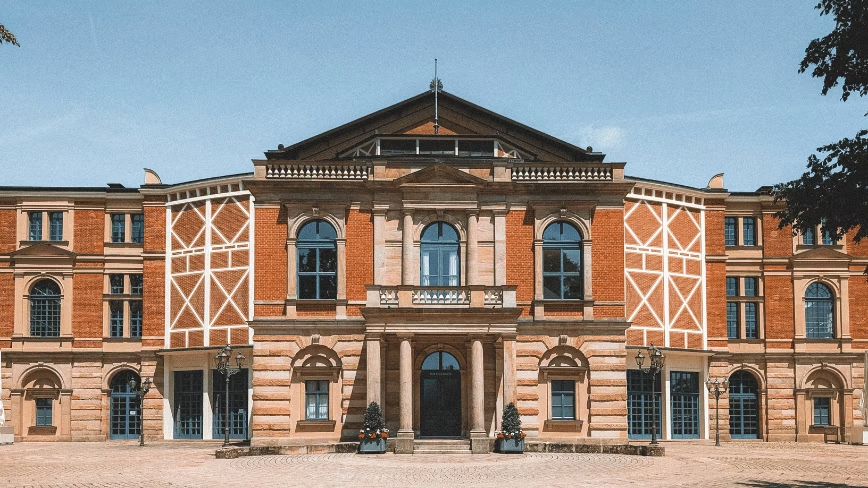
The Bayreuth Festival has spent 150 years guarding Richard Wagner’s music on a Bavarian hill. For its anniversary it tried something new and let artificial intelligence help stage the show. The crowd’s verdict was blunt. It booed the machine and cheered the humans.
The production, pointedly titled “Ring 10010110,” put AI on the festival stage for the first time in its history. At Saturday’s Götterdämmerung, the curator Marcus Lobbes and his team were met with boos and whistles at their bow, the Associated Press reported. The singers and conductor Christian Thielemann got warm applause. The music was fine. The machine was the problem.
Organisers had framed it as a grand experiment. “What happens when the stage itself begins to think?” the festival asked. AI would appear “not as a character, but as an image-generating force,” trained, it said, on countless images, voices, documents and past productions of the Ring.
The ambition was real. Rather than one staging, the machine would conjure many. It drew on the national myth, the political upheaval, the romantic utopia and the deconstructed shadow. These were the ways Germany has read Wagner over 150 years. In practice, the projections merged into a collage the audience struggled to follow.
That collage is where it lost the room. Among the shifting images were former Chancellor Helmut Kohl, the World Trade Center towers after 9/11, and a postage stamp marking German reunification in 1990. The cultural memory was there, in theory. The link to Wagner’s gods was harder to find.
A very old stage, a very new backlash
The timing sharpens the sting. This is Bayreuth’s 150th anniversary, and the German president, Frank-Walter Steinmeier, opened it by praising the festival’s “courage to renew itself.” Handing the visuals to an AI, led by the digital artist Roman Senkl, was exactly that. The audience answered with whistles.
It also lands in a wider mood. Audiences and platforms have spent the year pushing back on machine-made culture. A German court found Suno broke copyright, ChatGPT stopped imitating living authors, and LinkedIn added a button to flag AI slop. Big Tech has been quietly retreating from features it rushed out, as new EU rules force it to label synthetic content.
Bayreuth’s experiment is not over. The festival says every performance is different, because the images never stand still, and two more are scheduled, on 9 and 16 August. That gives the machine two more chances to win the room. On opening night’s evidence, it may collect two more rounds of boos.
Get the TNW newsletter
Get the most important tech news in your inbox each week.


