The B2B marketing playbook has a new top metric: whether a brand gets cited when a buyer asks an AI assistant a question. The brands that show up inside ChatGPT, Claude, and Google’s AI Overviews, are, with very few exceptions, the brands that also rank well on Google itself. AI visibility is correlated with search rank, not downstream of it.
That correlation is more complicated than it first looks. SEO growth advisor Kevin Indig published a correlation analysis earlier this year, drawing on 30,000 AI citations across 500 software categories, and found that none of the classic SEO metrics he tested had a strong relationship with citation frequency. “LLMs have light preferences: Perplexity and AI Overviews weigh word and sentence count higher,” Indig wrote. In a separate survey of 313 practitioners, he found 78 percent said their current approach to measuring LLM visibility is inaccurate.
What the rest of the data does suggest is that the AI answer engines reward roughly the same content qualities Google does, even if the surface-level metrics diverge. Substantive content, primary-source data, expert authorship, and structured E-E-A-T signals matter on both surfaces. A growing consensus inside the SEO community holds that the playbook teams should be running for AI visibility is the same one they should already be running for Google, executed against a wider source surface.
“In AI search, visibility depends on 3 things,” SEO consultant Ben Goodey wrote in a recent breakdown: “whether AI can find you, whether it trusts you, and whether it can understand and cite your content.” The brand-omnipresence consequence, with content published on YouTube, Reddit, TikTok, and the industry forums where buyers actually congregate, is the practical answer to the first of those three. AI engines pull citations from those surfaces, not only from a brand’s own site.
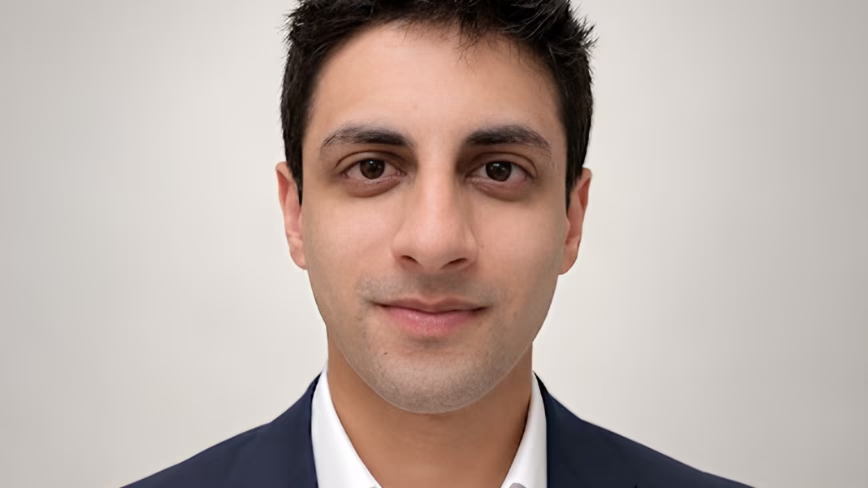
Hassan Rashid runs this playbook for B2B clients as managing editor at GrowthX AI, the content startup that pioneered the “service-as-software” category at the intersection of AI-augmented production and editorial discipline. GrowthX AI secured $12 million in Series A capital last year. Before content, Rashid spent two years as an associate product manager at Addepar, the wealth-tech platform Joe Lonsdale founded in 2009 that has more than $9T in AUM. His work spans venture-backed B2B and healthcare AI startups, including Alpaca Health.
At an enterprise B2B SaaS client, some of the strongest evidence sits inside the AI answer engines themselves. AI assistants now send the brand roughly 174 referred sessions a month across 26 of its articles, up from 23 a month earlier, and its content has earned 794 of the LLM citations tracked across the site, more than a third of the total. The Google side moved in parallel: across 44 articles, the content now draws about 1,731 organic clicks, more than 660,000 impressions, and 5,751 organic sessions a month, with monthly clicks more than doubling and impressions up 174 percent over the prior month. In the same window, that work drove 29 commercial conversion events, from free-trial requests and demo completions to a pricing inquiry and lead-generation form submissions.
A venture-capital firm Rashid produced content for showed a comparable shape. Over the same 90 days, 27 articles on the firm’s site took its content from effectively unranked to compounding traffic: monthly organic clicks grew 33x, from 34 to 1,108, and monthly impressions grew 14x, from 57,000 to 820,000, while sessions reached 1,672 a month and 2,777 cumulative, 4.8 times the program’s optimistic forecast. The work carried into AI search just as fast, lifting the firm from a negligible share to the second-highest AI-assistant visibility in its competitive set, with LLM referral traffic up 183 percent month over month and its page on the “AI wrapper” question now cited directly by ChatGPT.
At Alpaca Health, a Series A healthcare startup, Rashid led a rebuild of the company’s programmatic content footprint, replacing 238 generic vendor-template pages with location pages built from primary-source data on each city. The rebuilt Texas pages alone have driven 109 clicks on the company’s family intake form, 89 of them through the Texas state hub, now the highest-converting of the rebuilt location pages and the second-highest-converting page on the site overall. Site-wide, the family intake CTA recently hit an all-time high of 66 events in a single week. And the pages are starting to do what this kind of content is built for in an AI-search era: Alpaca is now cited inside Google’s AI Overview answers on more than fifteen conversational queries, like “which ABA therapy providers in San Antonio are in network,” each surfacing across 50 to 110 impressions.
The shared pattern across the three engagements is not a separate AEO discipline. The content runs through editorial infrastructure that applies primary-data substance, human-in-the-loop review, and named author authority surfaced in structured schema. Those signals are also what Google’s ranking systems are tuned to reward, which is part of why the same content surfaces on both.
What looks new under the AEO label is mostly the urgency of brand omnipresence that good SEO already required. AI engines pull citations from YouTube transcripts, Reddit threads, TikTok captions, organic mentions on the broader web, and the industry forums where domain experts congregate. Brands publishing only on their own site, however well that site is optimized, are missing the source surface AI retrievals draw from.
“Every company is now a content company,” Rashid said. “Buyers and decision-makers evaluate brands through Google, ChatGPT, Claude, and Gemini before they ever fill out a form. If you do not show up with substantive, expert-grounded content that the AI engines actually trust, you lose to whoever does.”
Indig’s correlation finding doesn’t complicate the “same playbook” view, it explains the nuances inside it. Most SEOs agree that AI visibility strongly correlates with Google rankings, even where specific classic metrics like page authority and link counts don’t predict AI citations cleanly. Word count, sentence structure, schema specifics, and the patterns AI retrievers actually pull from may matter more than some of the traditional ranking signals teams have been optimizing for. AI engines reward most of what good SEO rewards, plus a handful of things it doesn’t, and the operators investing now are running the playbook while calibrating to what each surface asks of them.
The discipline emerging under the AEO label is mostly the discipline most B2B marketing teams should have been running all along, with new urgency around omnipresence and surface-specific calibration. The citation evidence across Rashid’s engagements points the same way: brands investing now, in substantive content on the surfaces AI retrievers actually pull from, are already showing up across Google and the answer engines. Brands waiting are losing those citations to whoever moved first.
Get the TNW newsletter
Get the most important tech news in your inbox each week.
Contributed article. Opinions expressed by contributors are their own.
Also tagged with


