TL;DR
The ROG Xreal R1 offers 240Hz micro-OLED gaming on a 171-inch virtual screen for $849. Pre-orders are live, shipping June 1.
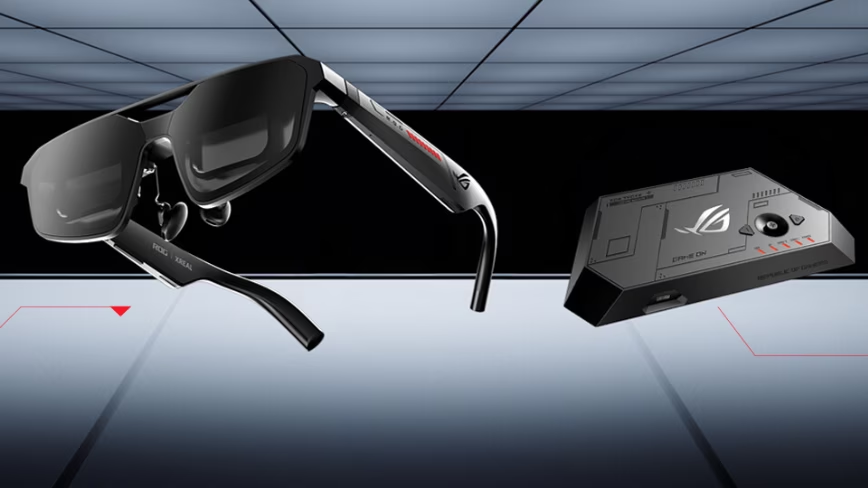
Asus-Gaming-Glasses
 Credit: Asus Republic of Gamers
The ROG Xreal R1 offers 240Hz micro-OLED gaming on a 171-inch virtual screen for $849. Pre-orders are live, shipping June 1.
Asus Republic of Gamers and Xreal have opened pre-orders for the ROG Xreal R1, the world’s first 240Hz micro-OLED gaming AR glasses. The device costs $849 on Best Buy, with Xreal’s own store accepting orders from 17 May. Worldwide shipping begins on 1 June.
The headline specification is the refresh rate. At 240Hz, the R1 doubles what any competing AR glasses currently offer, including Xreal’s own One Pro, which tops out at 120Hz and costs $650. The glasses use dual 0.55-inch Sony micro-OLED displays with a peak brightness of 700 nits, a 0.01ms response time, and Full HD (1,920 x 1,080) resolution per eye. The field of view is 57 degrees, which Xreal claims covers 95% of the wearer’s focused vision. The result is a virtual screen that appears 171 inches wide. The entire device weighs 91 grams.
Inside, Xreal’s X1 spatial coprocessor handles the menu system, 3DoF tracking (with support for 6DoF), and latency management. Motion-to-photon lag is rated at 3ms. The glasses feature electrochromic dimming across three levels, which automatically adjusts lens transparency based on head tracking, becoming transparent when the wearer looks away from the virtual screen and tinting when they re-engage. Audio comes from built-in Bose-tuned speakers.
The R1 ships bundled with the ROG Control Dock, a docking station with DisplayPort 1.4 and two HDMI 2.0 ports that lets users switch between three connected devices, a PC, a PlayStation 5, an Xbox Series X, or a Nintendo Switch 2, with a single button press. Without the dock, the glasses connect directly to any smartphone, tablet, laptop, or handheld with USB-C DisplayPort output. The ROG Ally integration is the most developed: the handheld becomes a live control panel for adjusting brightness, screen size, aspect ratio, tint level, and spatial settings while the glasses handle the gameplay display.
The product was first unveiled at CES 2026 in January and has undergone several months of optimisation since. Asus says it requires no additional software to get running, just a USB-C cable or the Control Dock. The glasses also support the Asus DisplayWidget Center app for adjusting settings from a laptop or desktop.
The competitive context is complicated. Meta sold more than seven million Ray-Ban smart glasses in 2025 and commands roughly 82% of the smart glasses market, but those are AI-powered audio and camera frames, not display devices. The Meta Quest 3, which offers a full VR headset experience with 6DoF tracking and passthrough AR, costs substantially less than the R1. The Xreal 1S, with a larger cinematic 500-inch screen and higher resolution but only 120Hz, launched at CES 2026 for $449.
The R1 is not a VR headset and does not compete on the same terms. It is a wearable external monitor, a pair of glasses that projects a flat virtual screen in front of the wearer, anchored in space or head-tracked depending on the mode selected. There is no hand tracking, no passthrough camera feed, no app ecosystem. What it offers is a 240Hz gaming display that fits in a glasses case, weighs less than most smartphones, and connects to any device with a video output. For competitive gamers who care about refresh rate and response time above all else, the specification sheet is compelling. For everyone else, $849 is a significant ask for a product that does one thing.
Apple is testing at least four frame designs for AI smart glasses targeting a 2027 launch, with no display in the first version. Google is preparing Android XR glasses for 2026 through partnerships with Samsung, Warby Parker, and Gentle Monster. The wearable display category is about to become significantly more crowded, but none of these products are targeting 240Hz gaming. The ROG Xreal R1 occupies a narrow but potentially defensible niche: the highest-refresh-rate wearable display for gamers who want a massive screen without the bulk, weight, or isolation of a VR headset.
Whether real-world performance matches the specification sheet will determine whether the R1 is a breakthrough or a curiosity. The X1 coprocessor was designed for 120Hz glasses, and its ability to handle 240Hz at scale is untested in consumer hands. The 57-degree field of view, while covering focused vision, is narrow by VR standards, and the 1080p resolution means pixel density decreases as the virtual screen size increases. Road to VR’s community has already noted that the effective sharpness is high at 44 pixels per degree, better than many VR headsets, but the trade-off between screen size and resolution clarity is real.
For the right buyer, a competitive gamer who travels with a ROG Ally, plays fast-paced shooters, and wants a 171-inch screen on a plane, the R1 could be genuinely transformative. For anyone whose primary consideration is value for money, the Meta Quest 3 and a comfortable couch remain the more rational choice. At $849, the ROG Xreal R1 is not trying to be rational. It is trying to be the best wearable gaming display ever made. Whether it is will be clear soon after the first units ship in June.
Get the most important tech news in your inbox each week.


