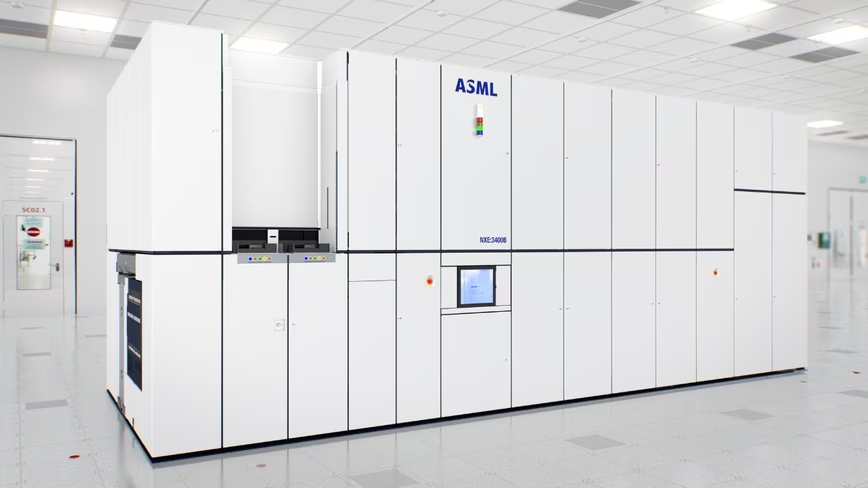
ASML’s new lab opens up access to its most advanced chipmaking machine
 Credit: ASML
The US has accused the one company on Earth that makes the machines behind cutting-edge chips of letting one slip into China. It has not shown its proof, and the company says it never happened.
In a series of recent meetings, Commerce Secretary Howard Lutnick told ASML’s senior leaders that Washington believes one of its top-of-the-line lithography machines may have made its way into China, in violation of US-led export restrictions. ASML, the Dutch firm that holds a near-total monopoly on the technology, denies it.
What the US is claiming
According to Bloomberg, Lutnick’s team believes it has evidence that ASML shipped EUV-related components and transport equipment to China, but has repeatedly declined to show it.
Extreme ultraviolet, or EUV, machines are the bottleneck for producing the most advanced semiconductors, and ASML is the only company that makes them. They have been off-limits to China since around 2019, and the dispute is the latest twist in a chip war that has repeatedly entangled the Dutch company.
ASML’s flat denial
ASML’s pushback is unusually direct. The company has circulated a document in Washington titled “No indication of any ASML EUV system in China”, and its statement leaves little room: it has “never shipped an EUV machine to China”, nor any “component, module or equipment specially designed to be used in an EUV machine”.
The accusation is hard to square
The commercial logic also cuts against it. ASML’s export licence is its lifeline, and even as China shrinks from about a third of its revenue toward a fifth, it remains the company’s single biggest market.
Torching that licence to arm one Chinese customer would be close to corporate suicide. That is the puzzle at the centre of the story: a serious allegation, no public evidence, and a defendant with every reason not to do what it is accused of.
The bigger squeeze
The clash lands as Washington leans harder on its allies. A proposed US law would force the Netherlands and Japan to mirror American export rules or face unilateral enforcement, and President Trump is reportedly pushing the Dutch hard.
The pressure is doubly awkward, because ASML’s future is increasingly American: it has just signed up to help build Elon Musk’s $55bn “Terafab” chip plant in Texas, even as Washington turns up the enforcement heat.
For ASML, the message is that compliance may no longer be enough. It now has to prove a negative, on Washington’s timeline, with a roughly $700bn valuation and its China business in the balance.
Until the US produces what it says it has, this is a standoff over an absence: one machine that may or may not be where it should not be, with the entire Western effort to keep advanced chipmaking out of China riding on the answer.
Get the TNW newsletter
Get the most important tech news in your inbox each week.


