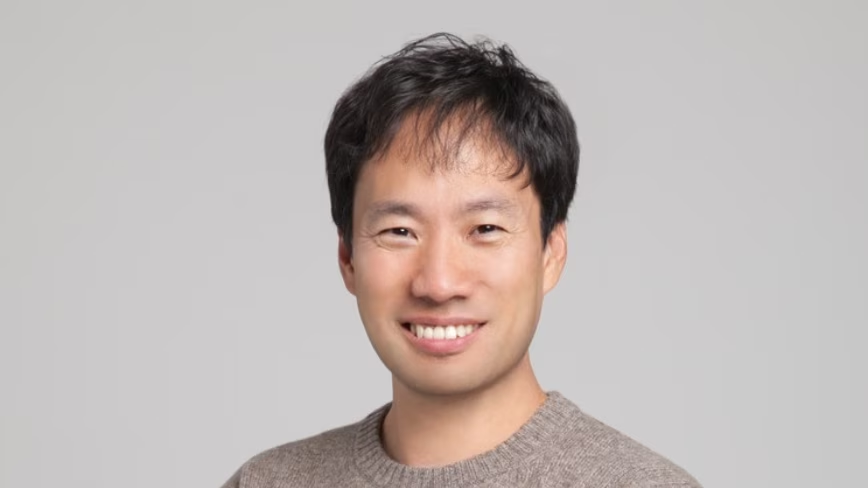
When the US government ordered Anthropic to cut foreign access to its most capable models, and the company switched them off worldwide rather than try to comply selectively, it handed every advocate of home-grown AI a tidy piece of evidence. Sung Kim, chief executive of the South Korean startup Upstage, picked it up at a briefing in Seoul on Tuesday.
“AI is no longer just a service or a tool we use; it has become a strategic national asset,” Kim told reporters, according to Bloomberg. The countries that control the foundational technology, he argued, the United States and China, can withdraw access whenever it suits them.
His conclusion was the one his company is built to serve: “We need to advance our own technology as quickly as possible and become as self-reliant as we can.”
The remarks land on a specific event. Anthropic disabled its Fable 5 and Mythos 5 models for all customers earlier this month after a US directive barred foreign nationals from using them, the first export-control measure aimed at particular AI models rather than at chips. For users outside the United States, the lesson was blunt: a tool they had built around could vanish on a decision made in another capital.
Kim’s framing is self-interested, and he would not pretend otherwise. Upstage is one of the companies that stands to gain if South Korea decides its AI should run on models it controls, and the sovereign-AI argument is, for him, also a business case. That does not make the underlying point wrong, only worth reading with the speaker’s position in view.
The argument is travelling. Since the Anthropic shutdown, similar conclusions have surfaced across the map: a debate in India over a national AI fund, a European push centred on Mistral with banking-sector backing, and a British coalition assembling a “sovereign” model to cut reliance on US technology. Korea’s version of the conversation now has a prominent voice attached to it.
Upstage is not a bystander to that policy debate. The company has been associated with South Korea’s national push to develop domestic foundation models, a programme in which the government has sought to back home-grown labs against the dominance of American and Chinese systems.
Its Solar model line is among the better-known Korean alternatives, and the company has pitched itself as a candidate to anchor the kind of sovereign capability Kim describes. When he argues that the country needs its own technology, he is also arguing for a role his company is positioned to fill.
What sovereignty means in practice is the harder question, and Kim did not pretend the path was short. Building and running frontier models domestically is enormously expensive, and few countries can match the compute and capital the American and Chinese labs command.
The case he made is that the alternative, dependence on infrastructure another government can switch off, is the larger risk. Whether Seoul agrees enough to fund it is the part still to be decided.
Get the TNW newsletter
Get the most important tech news in your inbox each week.


