 Credit: Anthropic
Anthropic says its Claude models designed working protein binders and ran a chemical-analysis job in minutes. It published the two experiments on Tuesday. The company reported the results itself. It framed them as early evidence that Claude can speed up parts of drug development.
Anthropic shared the work on its research blog.
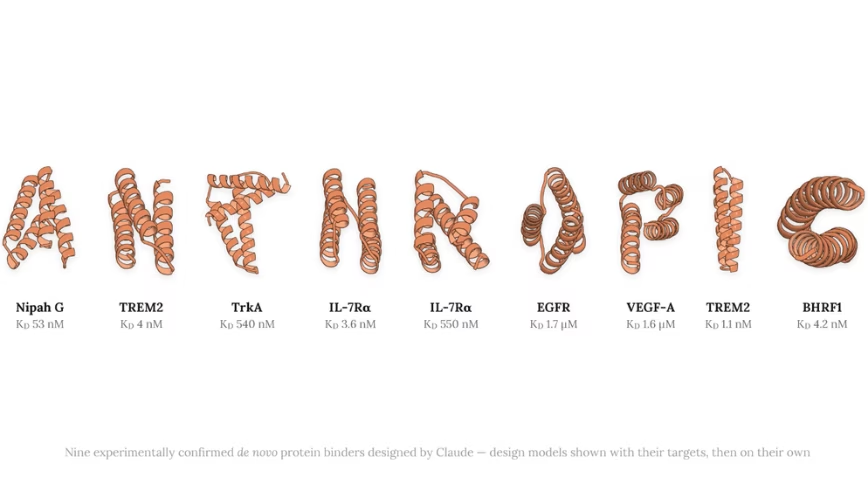
The headline numbers are Anthropic’s own. Claude designed protein binders against 15 targets and succeeded against 14, the company said. Between 22 and 35 percent of its designs bound to their target, depending on the setup. Anthropic says 10 to 15 percent is typical in the field today. Some of the strongest designs bound several times more tightly than the best previously published result, it added.
The wet-lab checks were not done in-house. Two outside firms, Adaptyv Bio and Twist Bioscience, independently produced and tested Claude’s designs, Anthropic said. That physical validation is the part of protein work that still takes weeks, whatever the software.
How Claude designed the binders
A binder is a small protein built to latch tightly onto a target, which is how many modern drugs work. Designing a new one from scratch, known as de novo design, has historically taken protein engineers months per target. The work overlaps with the wider field of AI drug discovery.
Anthropic used two models, Opus 4.8 and a preview of its Mythos model. It ran them inside Claude Science, its research workbench. The models got a long prompt, internet access, connectors and a large pool of GPUs. The company said it then left the models to work autonomously. Claude chose where on each target to bind, the company said. It orchestrated existing open-source design and folding models, then screened the candidates.
The compute was substantial. Anthropic gave the models up to 12,500 Nvidia H100 hours over a 48-hour session in one mode. A second mode used up to 2,500 H100 hours per target. Designing against one target at a time worked best, it said.
The Mythos preview hit a 35.1 percent success rate that way. In all, the campaign produced 354 confirmed binders from 1,320 designs.
Where it did well, and where it failed
Some results stood out. Against a target called RBX1, the Mythos preview hit a 40 percent success rate, Anthropic said. Human entrants in an Adaptyv Bio competition managed 3.7 percent. Claude’s top design beat the winning entry. Then there was TNFα, the protein that anti-inflammatory drugs such as Humira block.
Opus 4.8 designed binders that worked across human, monkey and mouse versions. Oddly, the Mythos preview failed on that target. Anthropic said it was not sure why the less capable model succeeded where the stronger one did not.
It did not work everywhere. Against maltose-binding protein, a notoriously smooth target, none of 90 designs was confirmed to bind, Anthropic said. It managed only modest results against BBF-14, a synthetic protein used as a hard benchmark. The company said it plans further testing to confirm its hit rates and binding measurements. It has released its prompts and data.
The chemistry test used a public model
The second experiment used Claude Opus 5, the most capable model Anthropic offers to the general public. The task was chemical analysis, the routine work of checking what a compound is and how pure it is. Chemists normally do this with two techniques, NMR and LC-MS, and the slow part is reading the raw files each instrument spits out.
Anthropic gave Opus 5 only the raw files from a contract lab and a two-sentence prompt, with no vendor software and no operator. Working inside Claude Science, the model returned processed results in 23 and 19 minutes, running the two analyses in parallel, the company said. Its numbers matched the lab’s. Purity came out at 96.4 percent against the lab’s 96.33 percent, and hydrogen counts were within a rounding margin.
Two details are worth noting. Claude caught and corrected its own error, Anthropic said, after a first pass overstated how many peaks had shifted in a follow-up reading. And it proposed the same confirmatory test the lab had independently run three days earlier. For the LC-MS file, which came in an undocumented vendor format, the model worked out the encoding and checked its reading against the instrument’s own totals before analysing anything, the company said.
The comparison Anthropic draws is with time. A chemist doing this by hand takes roughly 30 minutes to an hour per sample, and the lab’s finished report for this one arrived four days after the first measurement. Claude produced its report inside 25 minutes.
The results are self-reported, and dual-use
The findings come from Anthropic, about its own models. They have not been through outside peer review, though the two external labs tested the protein binders. The company said it assessed its models “holistically” and would publish more characterisation to confirm the figures.
Anthropic also flagged the risk in its own work. Autonomous biological design is dual-use, it said: the same capability that speeds up medicine could help a bad actor build a bioweapon.
For that reason, protein design and other sensitive biology tasks remain blocked on Claude Fable 5, its most capable model. It is building a vetted access program for scientists instead. The company has run its own tests on how far its bioweapon filters hold.
The context matters for how much to read into the results.
Anthropic’s own post notes that AI has moved fastest in fields such as maths, where an answer can be checked quickly. It has moved more slowly in the life sciences, where verification is expensive. It casts this work as foundational, and says it wants Claude to eventually run drug development end to end.
A designed binder, it acknowledged, is only the first step toward an actual drug.
Get the TNW newsletter
Get the most important tech news in your inbox each week.


