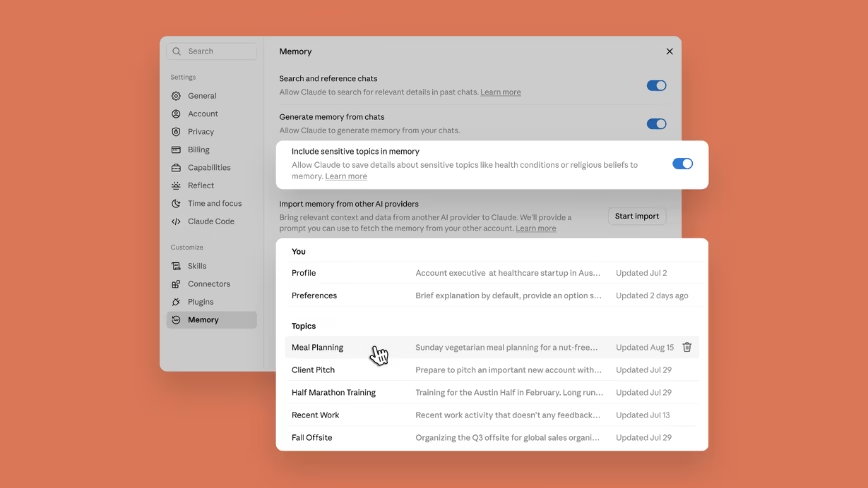
Claude’s memory settings allow users to view, edit, and control what information is saved across conversations.
 Credit: Anthropic
Anything you tell Claude in a chat window is now available to Claude Cowork. Anything Cowork learns comes back the other way.
Anthropic merged the two memory systems on Tuesday. Wherever you work with Claude, it starts from what it already knows about you, the company said in its announcement.
The feature is on by default for consumers, on the Free, Pro and Max plans, across web, desktop and mobile.
The second change is the one to notice
Claude now adds topics to memory while you are still talking. It used to wait until a conversation ended and summarise it.
Mention that a deadline moved to September, and the next conversation knows. You do not have to say “remember this”.
That changes when the system captures data. It also removes the pause at the end of a conversation, which is the point at which a user might have decided the exchange was not worth keeping.
What it looks like in use
Ask Cowork to draft an update for your manager and it knows who that is, and how she likes updates written. That is Anthropic’s own example.
Brainstorm a conference agenda in chat. Cowork then has the headcount, the city and the speakers when it builds the budget document.
Sarah Perez put it plainly for TechCrunch. The update makes Claude feel like one continuous assistant rather than two products under one roof.
You can read what it has kept
Everything Claude remembers sits as a list of files under Topics in the memory settings. Users can read, edit or delete each one, and a correction applies everywhere afterwards.
Users can pause or reset memory at any point. Two toggles control it, one for generating memory from chats and one for sensitive topics.
The sensitive-topics switch
By default, Claude stores nothing on health, race, ethnicity, religious beliefs, politics or gender identity. The company lists those categories and adds other similar areas.
Users can turn those on. What some people consider sensitive, others consider useful, Anthropic argues, and its example is a gluten allergy that should inform recipe suggestions.
The switch stays off unless someone moves it, and it does not work retroactively. Claude shows a notice each time it saves something in one of those categories.
David Gewirtz raised the obvious objection at ZDNET. If someone is struggling with something and wants help, a warning every time they discuss it may not be reassuring.
What it will not keep at all
Some categories stay out even with the sensitive switch on. Social security and government identification numbers, criminal history, immigration status, and anything breaching Anthropic’s acceptable use policy.
Claude tells the user when it cannot update memory with one of those.
Claude Code is not part of this
The announcement does not mention Claude Code at all. Gewirtz asked and was told the update is focused on Cowork and chat.
That leaves the coding tool as a separate memory island. It is also the clearest sign that this consolidation is not finished.
The surface is wider than two products
Cowork is the agent Anthropic released at the start of the year, and it has spread since. It moved onto phones in July.
Igor Bonifacic noted the timing for Engadget. A recent change put Cowork inside the Claude for Chrome extension. Conversations held in the browser side panel now form part of a user’s usage history.
Browsers are a sensitive place to add retention. Chrome has already drawn criticism for installing things silently that users never agreed to.
Claude has had memory since last summer, Bonifacic wrote. Those memories stayed fragmented, partly by design and partly because of the architecture.
Why the reach matters
Cowork is not a chatbot. It runs tasks, including in the cloud, and it operates on a user’s machine.
In July, researchers found that Claude Cowork could read credentials on a Mac after escaping its local virtual machine.
That is the reason the memory question is not the same as it would be for a chat window. A system that can act, and that now also carries months of accumulated context about its user, is a larger object than either half was.
Where the defaults change
Consumers get memory switched on. Team and Enterprise customers do not. Admins control availability for the organisation, and memory stays off for individual users until they turn it on.
Gewirtz reported the enterprise position slightly differently, as off for organisations by default and subject to eligibility. Either way, the split is deliberate, and it puts the burden of the decision on a compliance team rather than an employee.
That distinction lands hardest in Europe. Companies here have to document what personal data their tools retain, and a European regulator this month fined Uber 825 million euros over automated decision-making, which is a reminder of the climate rather than a comment on this feature.
The competitive picture
Memory is where assistants stop being interchangeable. The context a system holds is the thing that makes switching expensive.
Cursor is already building a Cowork rival. Both OpenAI and Anthropic have been folding separate desktop apps into single ones, Gewirtz noted, and shared memory is what makes that consolidation mean something.
Varun Mirchandani framed the intent for Digital Trends. Anthropic is trying to make memory feel less like a hidden trick and more like a workspace the user controls.
What users should actually do
The controls are in Settings, under Memory. Two toggles, a list of topic files, and a reset.
Anyone on iOS or Android needs the latest app version to see any of it. Anyone who wants sensitive topics remembered has to go and switch that on, and anyone who does not has nothing to do.
The one thing worth checking is the list itself. It is the first time Claude users can see, in plain files, exactly what the system has decided is worth keeping about them.
Get the TNW newsletter
Get the most important tech news in your inbox each week.


