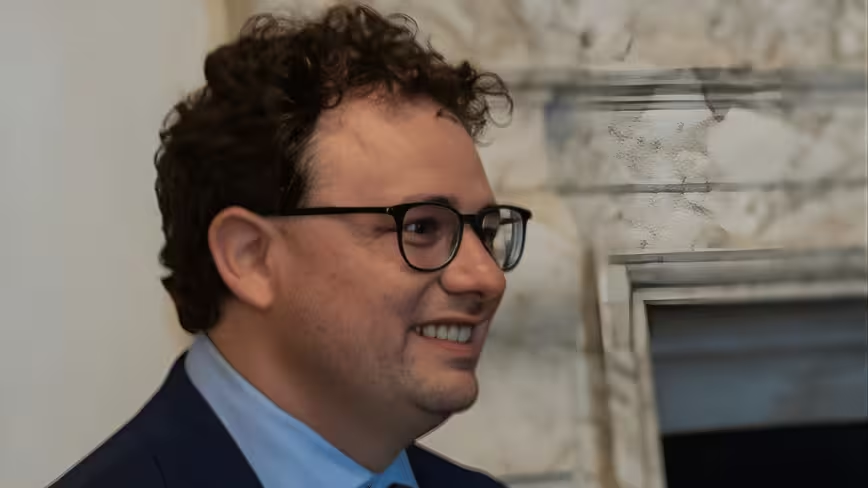
Dario Amodei in 2023
 Credit: UK primeminister
Summary: Anthropic CEO Dario Amodei is meeting White House Chief of Staff Susie Wiles on Friday to negotiate access to Mythos, a frontier AI model that can identify and exploit thousands of zero-day vulnerabilities across every major operating system and browser. The meeting follows Anthropic’s blacklisting by the Pentagon after Amodei refused to remove safety restrictions, and comes as US Treasury, the intelligence community, CISA, and UK financial regulators all seek access to the model through Anthropic’s controlled Project Glasswing programme.
Anthropic CEO Dario Amodei is scheduled to meet White House Chief of Staff Susie Wiles on Friday in what represents the most significant step yet toward resolving the company’s standoff with the Pentagon over its refusal to remove safety restrictions from its AI models. The meeting comes as multiple US government agencies, including the Treasury Department, the intelligence community, and the Cybersecurity and Infrastructure Security Agency, are seeking access to Anthropic’s Mythos model, a frontier AI system whose cybersecurity capabilities have triggered emergency briefings from Washington to London to Ottawa.
Mythos, announced on 7 April, is not a cybersecurity product. It is a general-purpose AI model that, during testing, turned out to be capable of identifying and exploiting thousands of previously unknown zero-day vulnerabilities across every major operating system and web browser. It found flaws that had survived decades of human security review and millions of automated tests. When directed to develop working exploits, it succeeded on the first attempt in more than 83% of cases. It is the first AI model to complete a 32-step corporate network attack simulation from start to finish.
Anthropic chose not to release Mythos publicly. Instead, it created Project Glasswing, a controlled access programme that provides the model to roughly 40 vetted organisations, including Amazon Web Services, Apple, Google, Microsoft, Nvidia, Cisco, CrowdStrike, JPMorgan Chase, and Palo Alto Networks, to find and fix vulnerabilities in critical software before they can be exploited. The company has committed up to $100 million in Mythos usage credits and $4 million in donations to open-source security organisations.
The Pentagon conflict
The White House meeting is the product of a dispute that has escalated since February. Defense Secretary Pete Hegseth demanded that Anthropic grant the Pentagon unfettered access to its models across all lawful purposes, including potential use in autonomous weapons systems and domestic surveillance. Amodei refused. Hegseth designated Anthropic a national security supply-chain risk, a label previously reserved for companies associated with foreign adversaries, effectively blacklisting it from government contracts.
Anthropic sued the Trump administration in early March, filing two federal lawsuits alleging illegal retaliation. A federal judge initially blocked the blacklisting, but an appeals court reversed that decision on 8 April, leaving Anthropic excluded from Department of Defense contracts while litigation continues. The company can still work with other government agencies.
The paradox is that the same government that blacklisted Anthropic now wants access to its most powerful model. The Treasury Department is seeking Mythos to hunt for vulnerabilities in its own systems. Parts of the intelligence community and CISA are already testing it. The White House Office of Management and Budget is setting up protections to allow federal agencies to use a controlled version. Axios reported that Anthropic has hired Trumpworld consultants to facilitate negotiations, and that Friday’s meeting is designed to pave the way toward a deal.
Why Mythos matters
JPMorgan Chase CEO Jamie Dimon said publicly that Mythos “reveals a lot more vulnerabilities” for cyberattacks. The UK’s AI Security Institute evaluated a preview version and found it “substantially more capable at cyber offence than any model previously assessed,” noting that it is the first model capable of chaining multiple attack steps into complete intrusions end to end. The Council on Foreign Relations called it “an inflection point for AI and global security.”
The defensive case for Mythos is straightforward: if an AI model can find vulnerabilities that human security teams and automated testing have missed for decades, giving that model to the organisations responsible for defending critical infrastructure lets them fix the holes before adversaries discover them. The offensive risk is equally straightforward: the same capability in hostile hands would be catastrophic. Anthropic’s decision to restrict access rather than release publicly is a direct application of the safety principles that put it in conflict with the Pentagon.
The company’s commercial trajectory gives it leverage in the negotiation. Anthropic’s annualised revenue has reached $30 billion, it has attracted investor offers at an $800 billion valuation, and it is exploring an IPO. It does not need Pentagon contracts to survive. What it needs is a resolution that preserves its safety commitments while restoring its ability to work with the broader US government, a position that the Wiles meeting is designed to explore.
The global response
Mythos has become a subject of concern well beyond Washington. The Bank of England’s Governor Andrew Bailey named it explicitly as a cybersecurity risk in a speech at Columbia University on 15 April. The Bank’s Cross Market Operational Resilience Group is convening an emergency briefing within the fortnight with the CEOs of the UK’s eight largest banks, four financial infrastructure providers, two insurers, and representatives from the Treasury, the Financial Conduct Authority, and the National Cyber Security Centre.
Anthropic is planning to provide Mythos access to select British banks within days as part of Project Glasswing’s expansion, and is quadrupling its London office to 800 staff in King’s Cross. The UK’s AI Security Institute, which has an existing evaluation partnership with Anthropic, published its technical assessment on 17 April. Canadian Finance Minister François-Philippe Champagne described Mythos as an “unknown unknown” being discussed at IMF meetings. Global regulators are coordinating on how to assess and manage the cybersecurity implications.
The geopolitical dimension is unavoidable. The US government’s desire for Mythos access exists in tension with its punishment of the company that built it. Anthropic’s willingness to provide the model to UK banks and regulators while locked in litigation with the Pentagon creates a situation in which America’s closest ally may have access to a critical national security tool before its own government does. That dynamic gives the White House an incentive to resolve the dispute that transcends the original disagreement over safety guardrails.
What a deal might look like
The outlines of a potential resolution are visible. Anthropic would restore its eligibility for government contracts and provide Mythos access for defensive cybersecurity purposes. The Pentagon would withdraw the supply-chain risk designation. Anthropic would maintain its restrictions on autonomous weapons and mass surveillance applications but potentially agree to a process for reviewing specific military use cases that do not cross those lines. Both sides have reasons to compromise: Anthropic because the blacklisting damages its enterprise credibility, and the administration because it needs the technology.
Whether Amodei and Wiles reach that kind of arrangement on Friday or simply begin the process of getting there is less important than what the meeting represents. The company that built the most capable cybersecurity tool in existence did so as a byproduct of building a general-purpose AI model, then restricted its release on safety grounds, then was punished by the government for maintaining those same safety principles, and is now being courted by that government because the tool is too valuable to ignore.
That sequence captures something essential about where AI governance stands in April 2026. The technology is advancing faster than the institutions responsible for managing it can adapt, and the companies that take safety seriously are simultaneously rewarded by the market and penalised by the state. Mythos is the sharpest example yet of a model whose capabilities are so consequential that restricting it and releasing it are both defensible positions, and the argument between them is playing out not in a research paper or a congressional hearing but in the West Wing.
Get the TNW newsletter
Get the most important tech news in your inbox each week.


