 Credit: Alison Schiebel
Anchr has raised a $5.8 million pre-seed round to automate the back office of America’s food distribution industry, a sector still running on phone calls, spreadsheets, and manual order entry.
On any given morning, the operations team at a mid-size food distributor might spend hours logging orders from restaurant clients, received by email, text, voicemail, and occasionally fax, into an ERP system that was probably designed before smartphones existed. They will chase late payments, reorder from suppliers based on intuition as much as data, and field calls from customers wondering where their delivery is. It is a business that feeds millions of people and moves billions of dollars of product. It is also, in large stretches, still running on manual labour.
Anchr, a New York-based startup founded in 2025, is betting that AI agents can fix that. The company has raised $5.8 million in pre-seed funding to build what it describes as the first end-to-end AI operating system for independent food distributors, automating workflows across order intake, procurement, inventory management, customer support, and invoicing. According to its founders, the company emerged from Andreessen Horowitz’s Speedrun accelerator programme.
The round was led by a16z, with participation from Offline Ventures, Long Journey Ventures, and Anterra Capital, a specialist food and agriculture venture fund. Strategic angel investors with backgrounds at OpenAI and other AI companies also participated, according to the company.
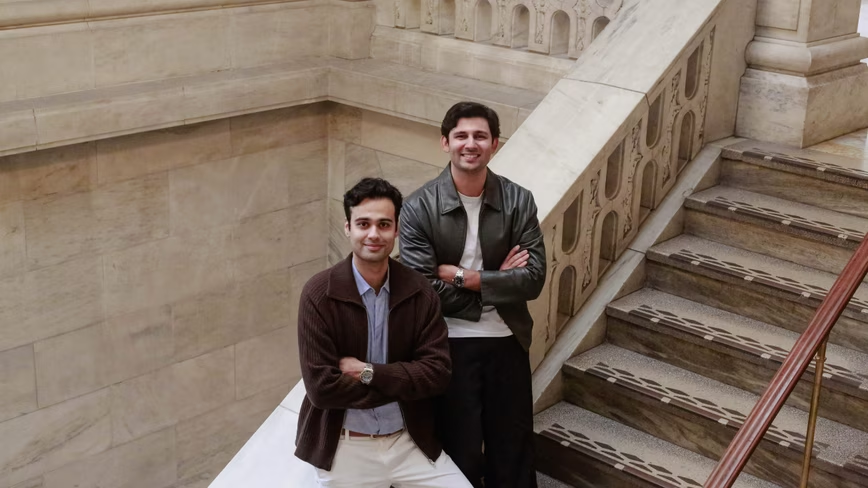
Anchr is run by two co-CEOs. Smayan Mehra studied computer science and engineering at Duke before spending time at Apple building vision models, then moved to data collaboration company LiveRamp, where he built AI products.
Tzar Taraporvala read mathematics and philosophy at Columbia, then joined McKinsey, where he led AI transformation projects across major companies in legacy industries, including, the company says, one of the largest AI rollouts in food services. The complementarity is deliberate: one founder with deep technical credentials in machine learning, the other with the consultancy playbook for getting AI to actually work inside large, slow-moving organisations.
The problem they are targeting is structural. Independent food distributors, the regional and specialist companies that supply restaurants, hotels, institutions, and retailers outside the reach of giants like Sysco and US Foods, account for a significant share of a market worth more than a trillion dollars annually in North America, according to industry figures.
Yet the technology serving them has barely moved. Most distributors run on ERPs built for manufacturing businesses, bolted together with spreadsheets, email inboxes, and tribal knowledge that walks out the door when a veteran employee retires.
Anchr’s pitch is not to replace those ERPs. Its website is explicit on the point: “no rip-and-replace.” Instead, the platform integrates with existing systems, including Aptean, Oracle NetSuite, QuickBooks, HubSpot, and Blue Yonder, and layers AI agents on top of them.
Those agents handle the work that currently consumes staff time: ingesting and reconciling orders from multiple channels, generating supplier purchase orders based on live inventory data, flagging at-risk customer accounts, and surfacing upsell opportunities by analysing order history and menu data.
The company claims its platform can cut order-processing time by half and reduce errors to near-zero. On its website, one customer president estimates his team was spending more than 40 hours a week logging orders manually before deploying Anchr; another describes procurement planning shifting from reactive to anticipatory.
What makes the vertical interesting to investors is not just the size of the market but its fragmentation. The food distribution sector is dominated at the top by two or three national players, but the long tail is thousands of independent operators who have neither the technology budget nor the internal engineering capacity to build their own solutions. That is exactly the kind of customer base where vertical AI software can establish deep, sticky positions before the larger players notice.
The $5.8 million will go toward expanding Anchr’s sales team, deeping integrations with the ERP systems its customers already use, and scaling the AI agents themselves. For a company selling into an industry that still takes orders by voicemail, it is a small round. Whether it proves sufficient depends on how quickly food distributors decide they are ready to stop doing things the way they have always been done.
Get the TNW newsletter
Get the most important tech news in your inbox each week.


