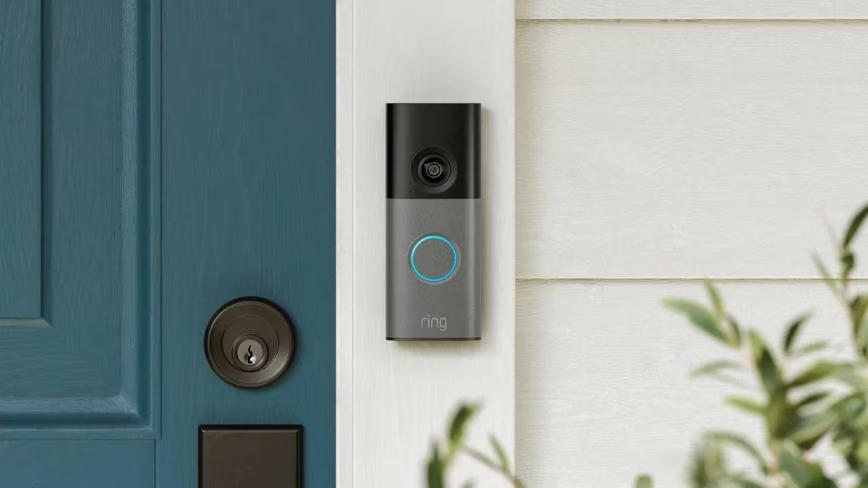
mazon was sued on Monday over the facial-recognition feature it recently added to its Ring doorbells, in a complaint that turns on a familiar asymmetry: the person who buys the camera consents to it, and the person walking past the camera does not.
Charles Sigwalt, a Virginia resident, filed the proposed class action in federal court in Seattle, alleging that Ring’s “Familiar Faces” feature captures and stores images of passersby without their permission. He is seeking at least $5m in damages on behalf of the class, according to Reuters.
Familiar Faces is an optional setting that uses AI to recognise people a camera has seen before, so that a notification can say who is at the door rather than simply that someone is. Ring rolled it out late last year as part of a broader AI refresh of its cameras, with users able to label recognised people and the system cataloguing a set number of faces over time.
For the homeowner who switches it on, that is the convenience. For the delivery driver, the neighbour, or the stranger cutting across the lawn, the suit argues, it means having a faceprint taken and retained with no say in the matter, and no practical way to opt out of a camera they do not own.
That objection is not new, and Amazon’s own conduct suggests it anticipated the legal exposure. The company has said Familiar Faces is not available in Illinois or Texas, the two US states with the strictest biometric-privacy laws.
Illinois’ Biometric Information Privacy Act requires written consent before a company captures someone’s face geometry and allows damages of $1,000 for each negligent violation and $5,000 for each intentional one, a structure that has made it the most expensive law in the country to fall foul of.
Keeping the feature out of those two states reads, to critics, less like caution than like an answer to a question nobody had to ask out loud.
The Sigwalt complaint sits in a longer line of trouble for Ring. The unit has drawn scrutiny for its facial-recognition ambitions for years, as well as for its data-sharing arrangements with police and a 2023 settlement with the US Federal Trade Commission over employee access to customers’ video.
Amazon, which bought Ring for about $1bn in 2018, has tended to frame the cameras as neighbourhood safety tools. The plaintiffs frame them as a privately owned surveillance network that happens to point at the street.
What happens next is procedural. The court has to decide whether the case proceeds as a class action, and Amazon has not yet filed a response to the specific allegations.
An earlier biometric suit against Ring survived a motion to dismiss in 2022, which gives the new claim a precedent to lean on, though not a result. For now there is a filing, a damages figure, and a feature that keeps scanning faces while the lawyers argue over whose consent it needed.
Get the TNW newsletter
Get the most important tech news in your inbox each week.
Also tagged with


