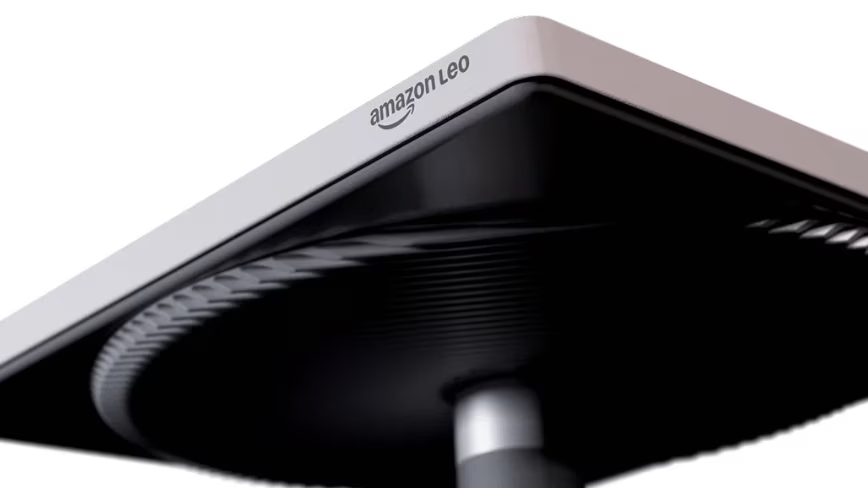
 Credit: Amazon Leo
Amazon has finally reached the starting line in the satellite-internet race. It says it now has enough spacecraft in orbit to switch on its Leo broadband network later this year. The target is clear: Elon Musk’s Starlink.
An overnight launch on 2 July tipped the balance. A United Launch Alliance Atlas V rocket carried 29 more satellites into orbit from Cape Canaveral. That brought Amazon Leo’s constellation to about 396 operational satellites.
“Enough to support continuous service across initial latitudes,” the network’s vice-president of business and product, Chris Weber, said in a post. Amazon confirmed that initial commercial service will begin this year, hitting a mid-2026 target it set earlier.
There is a catch, and Amazon is upfront about it. Coverage will be patchy at first. Service starts in a narrow band at mid-latitudes, then creeps toward the equator as more satellites go up. Early users should temper their expectations.
A distant second
The gap with Starlink is vast. SpaceX has roughly 10,000 satellites in orbit and more than 10 million subscribers. It launched in 2015, four years before Amazon even announced its rival network.
For scale, SpaceX opened its own “better than nothing” beta back in 2020 with about 900 satellites. Amazon is switching on with roughly 396. Catching up will take years and thousands more launches.
Thursday’s flight was the last of eight Atlas V missions Amazon had reserved. From here it leans on ULA’s bigger Vulcan rocket, plus Jeff Bezos’ Blue Origin, Arianespace and even SpaceX. In total, Amazon has booked around 100 launches worth some $82bn.
Grounded rockets
Getting those satellites up has been the hard part. Amazon needs a fleet of working rockets, and two of its key rides sit grounded. A Blue Origin New Glenn exploded on its launch pad in May, destroying the tower. Vulcan has been stalled since February over a rocket-motor fault.
Amazon says New Glenn should fly again by year-end. Until then, the deployment schedule that worried regulators stays tight. The first-generation network is meant to reach 3,232 satellites by 2029, with a far larger second generation already approved.
The bigger prize
Broadband is only part of the plan. Through its $11.6bn purchase of Globalstar, Amazon is chasing the direct-to-device market. It has agreed to power Apple’s iPhone satellite features from 2028, putting it head to head with Starlink’s own phone ambitions.
The race matters beyond the two US giants. Starlink’s dominance has unsettled governments wary of leaning on one company, and Europe has struggled to mount a serious answer. A recent $3.1bn satellite merger was judged too small to rival Musk. For all its lateness, a credible Amazon means the sky is no longer a one-horse race.
Get the TNW newsletter
Get the most important tech news in your inbox each week.
Also tagged with


