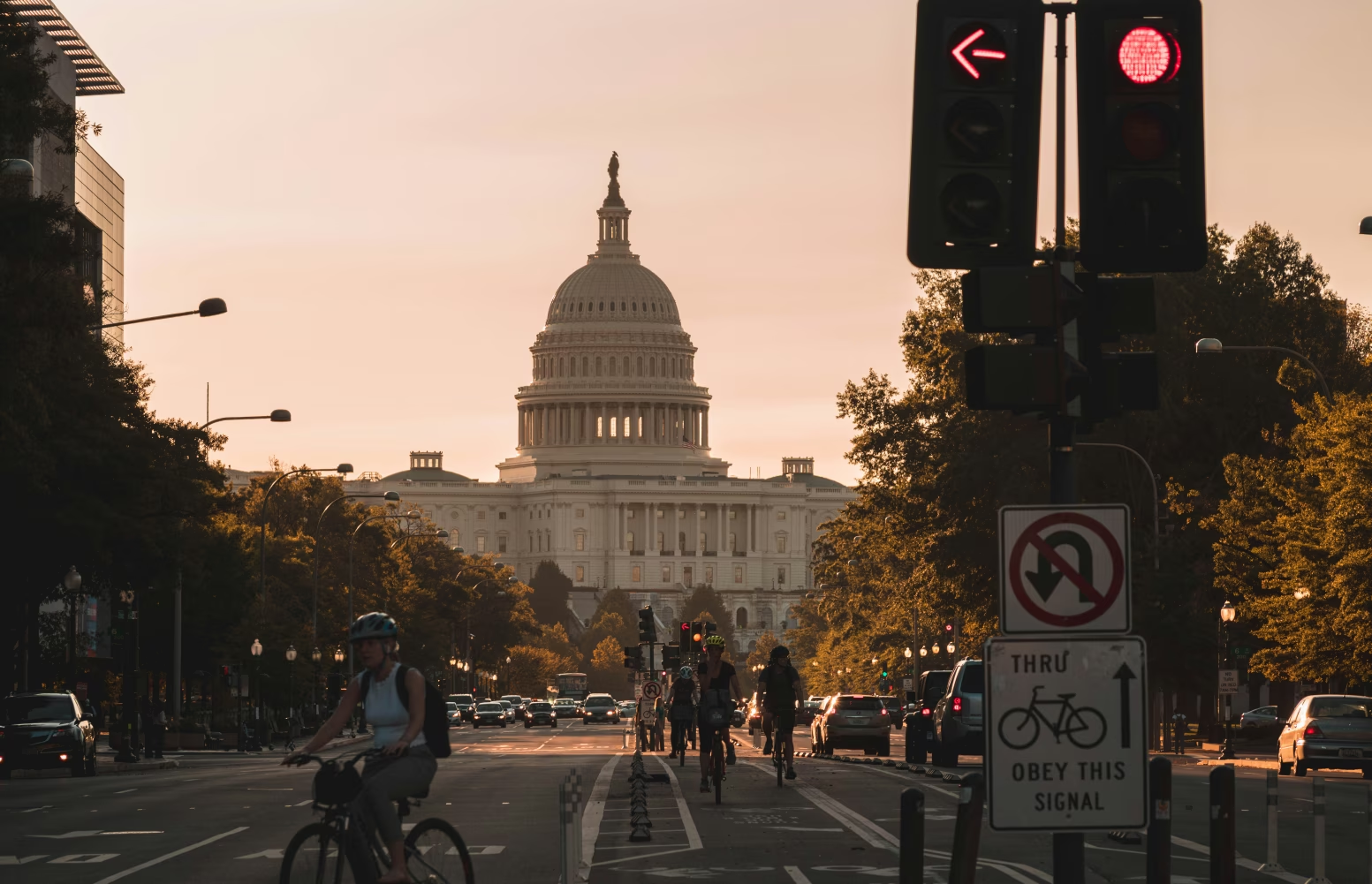
United States Capitol, First Street Southeast, Washington, DC, USA
 Credit: Andy Feliciotti on Unsplash
The AI industry’s biggest bet on a competitive general election race lost on Tuesday. Two super PACs linked to Leading the Future spent $4.8M backing Republican Darline Graham in South Carolina’s Senate race. She lost to Democrat Annie Andrews, who had called her “Data Center Darline”.
Most Republicans backed by either side of the AI industry’s spending fight lost, Fortune found in its tally of the closest races. It was the same night voters rejected AI data centres in 40 of 41 ballot measures. AI super PACs spent $79M across 68 House and Senate seats this cycle, according to Tech Influence Watch, a tracker run by writer Molly White.
Two camps
The money comes from two networks. Leading the Future wants light regulation and a single national AI rulebook that overrides state laws. Andreessen Horowitz co-founders Marc Andreessen and Ben Horowitz gave it $25M each, according to filings reviewed by Fortune. OpenAI president Greg Brockman and his wife, Anna, are also among its biggest donors.
Public First, which has significant backing from Anthropic, wants stronger safeguards. Both networks run one arm for each party.
Leading the Future launched in August 2025 with a war chest of around $100M, WIRED reported. It ends the cycle with just over $20M in the bank. In October, OpenAI chief executive Sam Altman said AI money in politics was clearly not working.
Where the money went
The biggest fight came in June, in the Democratic primary for New York’s 12th District. Leading the Future spent more than $8.1M against Assemblymember Alex Bores, a co-author of the state’s RAISE Act. Public First spent about $15M backing him. Bores lost, finishing second to Micah Lasher, who also campaigned on AI safety.
Leading the Future then spent about $10M in the general election, mostly on safe seats, WIRED reported. Its Republican arm, American Mission, spent $590,428 backing Aaron Flint in Montana’s 1st District and $509,067 behind Laurie Buckhout in North Carolina’s 1st. Both conceded. Its Democratic arm, Think Big, backed Florida Rep. Jared Moskowitz, who won.
Public First’s Republican arm had a similar night. Defending Our Values spent $1.49M backing Carlos De La Cruz in Texas’s 35th District and $974,908 behind Rhett Marques in Alabama’s 2nd. Both lost. It also spent $857,426 backing Scott Singer against Moskowitz. Its Democratic arm, Jobs and Democracy, backed two winners in Ohio and Pennsylvania.
A conservative AI group, Alliance for a Better Future, spent just over $1M backing Mike Rogers in Michigan and $810,000 behind Susan Collins in Maine, Molly White wrote. Both lost.
Guardrails Alliance, a tech worker group pushing for stricter rules, spent more than $1M each against Flint and California Rep. Jimmy Gomez, TechCrunch reported. Gomez lost to Angela Gonzales-Torres.
Both sides read the night
Groups pushing for stronger rules claimed the result.
“Voters in both parties delivered the same verdict tonight. This is a crushing blow to the AI industry’s anti-regulatory efforts to buy a Congress that would look the other way.” Brad Carson, Public First Action, to WIRED
“Allying with the worst parts of the AI industry is just kryptonite for a campaign, and the results tonight double down on that.” Alex Bores, to Politico
Charlie Blaettler, Guardrails Alliance’s political director, told TechCrunch that Leading the Future held back in close races because its money would have become a liability for its candidates.
“Our goal is to make AI money politically toxic.” Charlie Blaettler, Guardrails Alliance, to TechCrunch
Before the vote, Leading the Future told TechCrunch that primaries are a better use of its money, because spending there builds name recognition and helps candidates set AI agendas. It said it would keep spending in 2028. It also leaves the cycle with dozens of winning candidates from both parties, WIRED noted, most of them in safe seats.
A Republican lobbyist pointed to the party’s message on AI.
“It’s proven to be incredibly unpopular, and ‘beat China’ did not resonate at all in places that it really needed to.” Greta Joynes, Brownstein Hyatt Farber Schreck, to Politico
Bores is already preparing for the next round. His new nonprofit, Who Decides, aims to raise $30M before 2028, Fortune reported.
Get the TNW newsletter
Get the most important tech news in your inbox each week.


