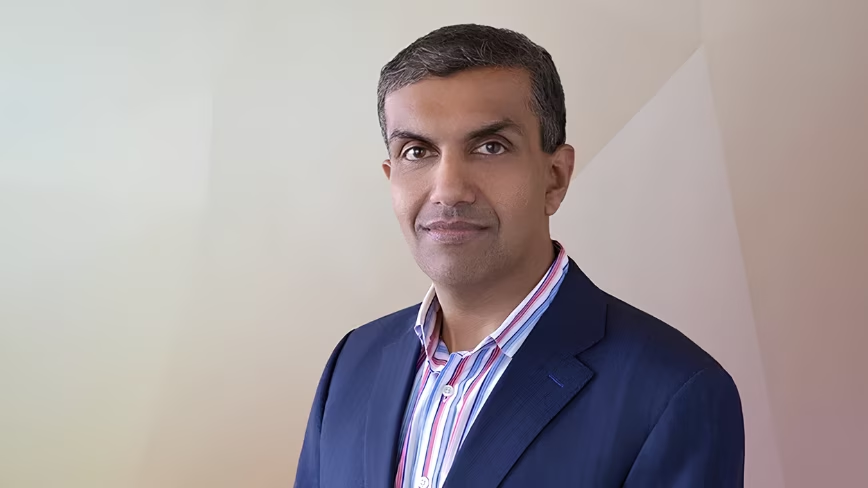
Anil Chakravarthy, President, Customer Experience Orchestration Business, future CEO of Adobe from 1st of December 2026

Adobe named Anil Chakravarthy president and chief executive from 1 December, with Shantanu Narayen moving to executive chair. Chakravarthy came up through Digital Experience and worldwide field operations, arrived from enterprise data company Informatica, and championed the Workfront and Semrush acquisitions. The argument here is that the board has picked a leader from the side of Adobe that generative models do not directly threaten.
Adobe’s board said in a statement on Wednesday that Anil Chakravarthy will become president and chief executive on 1 December and join the board, with Shantanu Narayen moving to executive chair. Frank Calderoni, the lead independent director who chaired the selection committee, said the board decided unanimously after a rigorous process.
Read the CV rather than the quotes. Chakravarthy joined Adobe in January 2020 to run Digital Experience, added worldwide field operations that September, and became president of both in December 2021.
Where he actually comes from
Before Adobe he spent four years as chief executive of Informatica, an enterprise cloud data management company, having joined it in 2013. Earlier roles were at Symantec, VeriSign and McKinsey, and he holds a master’s and a PhD from MIT.
Inside Adobe his record is enterprise software rather than creative tools. He led CX Enterprise, GenStudio and Brand Visibility, scaled Adobe Experience Platform, and championed the acquisitions of Workfront and Semrush.
That is a marketing and data lineage from end to end. The person now running Photoshop’s owner has never run Photoshop.
Why that reads as a strategic choice
Adobe’s creative tools are the part of the business most directly exposed to generative models. Competitors have reached serious scale quickly, and Freepik rebranded as Magnific as a bootstrapped, profitable AI creative platform on $230m of annual recurring revenue.
Customer experience orchestration faces no comparable threat. Enterprise data plumbing, campaign tooling and the systems that connect them are defended by integration depth and switching costs rather than by model quality.
Appointing the person who built that side is a statement about where the board thinks durable growth sits. It is not a repudiation of the creative business, but it is a ranking.
The word in his own quote
Chakravarthy said he is energised by the chance to drive Adobe’s leadership in “the next era of agentic software for creativity, productivity and customer experience”. Creativity comes first in that list and is one of three.
Narayen framed the handover in similar terms, saying he is confident Chakravarthy is the right person to lead Adobe’s growth in an AI-driven era. Neither quote mentions a specific creative product.
The agentic framing is not new to Adobe. Its Firefly assistant already turns Creative Cloud into a conversational layer over the individual applications, which is the same architectural bet applied to designers rather than marketers.
What the acquisitions tell you
Semrush is the one to look at. Buying a search and marketing intelligence company fits a company preparing for a world where brands need to know whether AI systems mention them at all.
That deal arrived alongside Firefly agent work, a Disney tie-up and LinkedIn integration, and Chakravarthy is credited in Adobe’s announcement with championing it. Brand Visibility, one of the products he is credited with, points at the same problem.
The creative side has been buying too. Adobe agreed to acquire Topaz Labs in June for its image and video enhancement models, so the pipeline is not being starved.
The transformation he inherits
Narayen’s tenure is defined by moving Adobe from boxed software to subscription, one of the most studied business model changes in enterprise technology. The comparison being invited is that a second transformation is now required.
The difference is that the first one changed how Adobe charged for the same products. This one concerns whether some of those products remain the reason anyone pays.
Distribution is shifting underneath as well. Adobe has put more than 70 of its tools inside ChatGPT, which extends reach and also concedes that the starting point for a creative task may no longer be an Adobe application.
The case against this reading
There is a fair counter. Adobe has pushed AI into its creative products aggressively rather than defensively, and Firefly’s audio, video and assistant work suggests a company competing on model integration rather than retreating from it.
Chakravarthy’s enterprise background may also be exactly what the creative business needs, since the hard problems there are increasingly about data, permissions and workflow rather than filters. An operator who has scaled a platform is a defensible choice regardless of which division he came from.
It is also worth noting that he ran worldwide field operations covering the full portfolio, including creativity and productivity, so his exposure is broader than the Digital Experience title suggests.
What to watch
Adobe reports Q3 FY2026 on 10 September, a week after this announcement and nearly three months before Chakravarthy starts. Sequencing a succession ahead of results rather than after them is a choice, and the call will be Narayen’s to answer.
The number that matters is the split between Digital Media and the experience business, and how each is growing. A chief executive drawn from one side will be read through that line for as long as he holds the job.
Watch the first acquisition too. Where a new chief executive spends money in year one says more than any transition statement, and Adobe has been an active buyer all year.
Get the TNW newsletter
Get the most important tech news in your inbox each week.
Also tagged with


