We love a third-party mockup at TNW as much as anyone, but when someone does the leg work to doodle something that we have thinking about in the backs of our minds, it’s all the better. Today we have something to share with you that should excite.
It is well-known that Windows 8 is designed in part to run on tablet hardware. Also, Nokia, creators of the rather beautiful Lumia line of smartphones, has been tipped as set to build Windows 8 tablets when the time comes. Taking the idea of Windows 8, and Nokia’s hardware, and putting them together is a mental exercise worth enjoying.
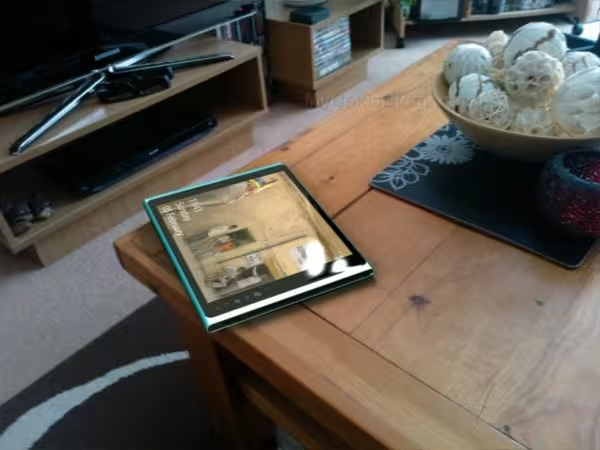
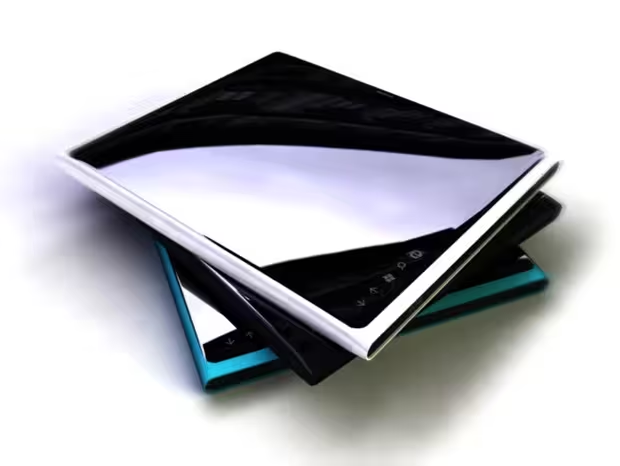
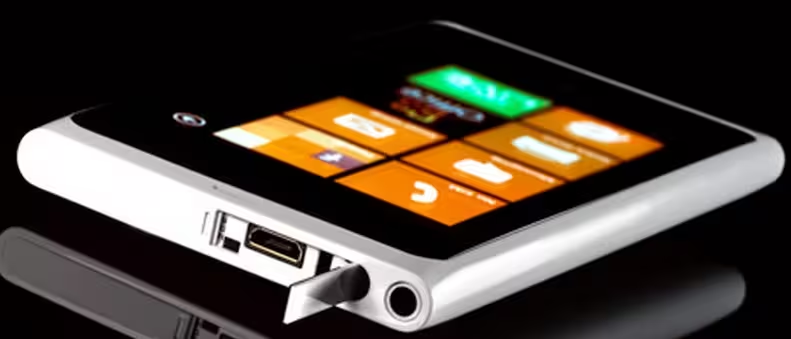
Happily, that’s exactly what our mockup from MyNokiaBlog envisions. We’ll cut the chase and get to the pictures:

To quote Reddit, if these existed, it would be a ‘Shut Up And Take My Money’ moment. The creator of the mockup envisioned the device as having the following specifications [TNW notes in brackets]:
- A 1.4GHz cpu
- 512Mb ram [This could be changed to 1 Gb, we think]
- 16/32/64Gb storage [Tiered pricing is an interesting idea]
- 9.7″ AMOLED “clearblack” display (1280×800)
- 8Mp Rear camera, 2Mp front facing camera
- Windows 8 tablet edition [We assume that he means Windows 8 Home, or whatever it ends up being called]
- Wifi/3G connectivity [Windows 8 tablets may be carrier subsidized, which is a very interesting proposition]
The success of Windows 8 in tablet form is very much a dynamic equation. Even if Windows 8 is a very polished piece of software, bad mobile hardware could snuff its chances of moving any significant number of tablets. In short, Windows 8 needs devices like the above unit, but probably with a dual core processor, to be built.
It’s fun to see what enthusiasts come up with, but this is merely a foretaste. We can’t wait to see what Nokia cooks up itself.


So far behind what? The mobile devices everyone is enamored with today are the Windows 3.1 of the 90's.
Don't confused this with iOS/Android bashing -- we are simply in the infancy of mobile computing. We've (for the short-term) traded access to information with universal applicability and productivity. We've gotten rid of (temporarily, anyway) plugins (read: platform unification), for short-term problems; the platform/phone/browser is now the plugin. Obviously there was overhead in the last-gen plugin king, flash, for mobile computing. Obviously forcing better standards into the new 'plugins' is a step forward. But ultimately these devices don't conquer every user, with every piece of functionality, etc.
Mobile computing is only as productive as the particular app developer streamlines the interaction, along /their/ rigid pathways. That's very similar to the Apple paradigm of old. Windows, at its core, has always been about providing a completely flexible platform which enables productivity at the leisure of the user. One is a short-term goal, the other is long term. Which has capitalized short-term? And which will capitalize long-term? You do the math. If the overtaking of mobile computing by iOS/Android (Blackberry even!) should teach us anything, it's that market share in a rapidly-changing market is fickle, at best.
Android is very much like MS in this regard -- and as a result its no wonder they've carved out the market share they have. And while Google has products that unify the experience in similar ways to MS's vision, MS is what most people use to get there. MS creating a gaming console? Horsepoo, you say.. but look at it now. All that really means is Nokia and MS have a better chance at coming out ahead in the near future. They are keeping quiet and focusing on the products; letting the fragmented and myopic euphoria-driven-consumerism evolve right into their hands. They (MS/Nokia) /were indeed/ late to the game when it comes to next-gen smartphones that compete with iOS/Android .. but they led the productivity/user-enabling generation of them. Microsoft's core user-base is really not the Staple's button user -- it's the information worker, the creator of the tools on which the consumer relies.
Everything they are doing is setting them up to take off where everyone else will be lagging behind when the time comes to unify platforms, mobility, ease of use, and most importantly, prosumer productivity.
- spam
- offensive
- disagree
- off topic
LikeConversation from Facebook
I wouldn't buy Nokia no matter what they did . Too late
looks good!
Nokia are so far behind