
The American Booksellers Association (ABA) is the latest body to join the slew of retailers Stateside boycotting books from Amazon’s publishing division.
The ABA is the USA’s national, not-for-profit trade association which exists to protect and promote the interests of its members: independently owned bookstores of all sizes, with storefront locations across the country.
Barnes & Noble announced last week that it was taking the noble decision to ban Amazon’s books from its 700+ US stores, off the back of Amazon seeking exclusive deals with publishers and associated parties.
“Barnes & Noble has made a decision not to stock Amazon published titles in our store showrooms,” said Jaime Carey, Chief Merchandising Officer and Barnes and Noble. “Barnes & Noble Our decision is based on Amazon’s continued push for exclusivity with publishers, agents and the authors they represent. These exclusives have prohibited us from offering certain eBooks to our customers.
“Their actions have undermined the industry as a whole and have prevented millions of customers from having access to content,” he continued. “It’s clear to us that Amazon has proven they would not be a good publishing partner to Barnes & Noble as they continue to pull content off the market for their own self interest. We don’t get many requests for Amazon titles, but If customers wish to buy Amazon titles from us, we will make them available only online at bn.com.”
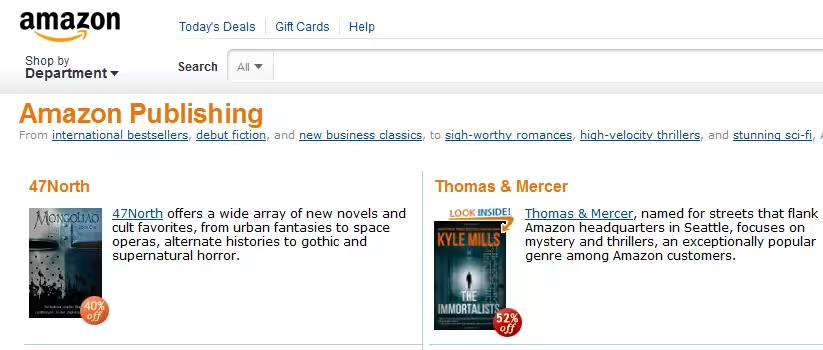
Whilst it was an interesting caveat to still offer Amazon titles online through its website, the message was clear nonetheless. Next to stick the boot in were Canadian booksellers Indigo and Books-a-Million,which held similar disdain for Amazon’s actions.
“In our view Amazon’s actions are not in the long-term interests of the reading public or the publishing and book retailing industry, globally,” said Indigo’s vice-president Janet Eger. “Indigo founder and c.e.o Heather Reisman has congratulated Barnes & Noble for taking a leadership stance on the matter, and offers kudos.”
Now, Publishers Weekly reports that the ABA-owned IndieCommerce, a for-profit company for independent booksellers, has removed all Amazon-published titles from its database. Matt Supko from IndieCommerce’s wrote to booksellers saying:
“While Amazon is seeking to distribute its print catalogue through conventional means, it seems that they are simultaneously pursing a strategy of locking in e-book exclusives which other retailers are not allowed to sell. IndieCommerce believes that this is wrong.”
To coincide with this, IndieCommerce has also initiated a new policy stating that “Only publishers’ titles that are made available to retailers for sale in all available formats will be included in the IndieCommerce inventory database.”
In May 2009 Amazon began its first foray in the publishing sphere launching AmazonEncore to “help readers discover exceptional books from emerging authors,” though it did announce that it would publish titles that have gone out-of-print.
Whilst the anti-Amazon sentiments are riding high, the real impact of these moves will be minimal, given the relative small scale of Amazon’s publishing division, and also given that the books are still for sale via one of the most popular retail avenues of all…Amazon.com.


This may look like "about unable to compete", but there is far more that underlies this matter that should be considered. Amazon's actions are effectively an attempt to monopolize publishing. We lost so many small and independent publishers a few deacades ago, and publishing has not recovered (leaving new authors and indie booksellers in position which is, at best, precarious). Why support an entity which continues this deeply damaging trend ??? Further, Amazon can never offer the sort of browsing and discovery value found at a bookstore - if its hard to get new authors published and exposed now, Amazon's actions will only make the situation worse ! Their comparison app has further damaged storefront business; if new authors and indie publishing and also then indie bookselling are ever to survive and flourish, then supporting Amazon is a non-option. Why patronize an entity that attacks diversity in publishing, community business, and needed tax revenues for our towns, communities - including the schools where new readers are educated ?
- spam
- offensive
- disagree
- off topic
Likeakebia I TOTALLY agree with you when it comes to the value of bookstores and store fronts. I am not saying that ABA or B&N should support Amazon. I am saying that they have had the ability to compete for a long time and have not done so.
And now, they have taken totally symbolic actions that will not hurt Amazon, but will hurt themselves, their customers (depriving them of many worthy books) and the indie author movement.
Right now, the indie author movement has only one company giving it the tools and the ability to make a living, and that is Amazon. I'm not comfortable with that, but ABA, B&N and others have abdicated any competitive responsibility they have had. It's not too late, but they should get moving rather than obstructing.
I am fortunate to have had 20 previous books published by legacy publishers (a few bestsellers among them) but I see indie publishing as a future worth pursuing. I'd like to have a lot of retail partners in that venture. But right now, Amazon is the only real game in town.
- spam
- offensive
- disagree
- off topic
Likelperdue I've been in the book business for nearing three decades; it is much harder for new authors to get published now. The collapse of many quality small presses and bookstores was a heartbreaking experience ! But after watching this sector for years, going with Amazon is imo a no-go. I would like to see authors develop cooperative "brands" akin to publishers, so that they can support one another, bring in new authors, and help readers to identify books that might interest them. (For example, I always liked Fromm, and considered their name a recommendation to buy, and still do w/ Dalkey Archive Press ...). Instead of joining onto an existing and dangerous behemoth, help to restore truly democratic publishing !
- spam
- offensive
- disagree
- off topic
Likeakebialperdue I think authors would love to take the route you have suggested. I certainly would.
But the only road available is the one paved by Amazon. Authors would take other roads if they were open. That's my point about competing.
Yes, the book publishing world certainly has changed and not for the better. My first book was published in 1974 and my last one with a traditional publisher (St. Martin's-Tor/Forge) was 2005 and a highly dissatisfying experience with incompetence that transcends belief.
Publishing still has not a clue about what to do, how to compete, how to build a road for authors or where the road should lead. Sad as it is, until they do, all they can do is whine, delay and obstruct ... hurting authors all the way ... but not touching Amazon who owns the only existing road.
I wish I could go back to my publishers of the 1980s and I wish I could walk the path you've outlined -- it is certainly far preferable. But, reality is cruel and we can only work with it as best possible.
- spam
- offensive
- disagree
- off topic
LikeThings got so heated on Publisher's Weekly that they deleted more than 60 comments and replies on the issue. It all started when I posted this: "Indie Booksellers Tell Indie Authors To Go To Hell" (http://lewisperdue.com/?p=1221) and people realized the biggest issues are: Amazon's competitors can't compete and, indie authors are the biggest casualties in a boycott campaign that is as effective against Amazon as Occupy is against Goldman Sachs.
- spam
- offensive
- disagree
- off topic
Likerestarted the comments a couple of hours ago.
- spam
- offensive
- disagree
- off topic
Like