
Last week, Facebook announced that journalists using its new “Subscribe” tool have seen a 320% uptick in subscriptions since the tool’s launch last fall. Facebook has made it clear that it wants this tool to compete with Twitter and to break Twitter’s dominant position as the platform for breaking news.
But Facebook Subscribe in its current state can’t compete with Twitter. Why? Because Twitter offers a crucial element that Subscribe doesn’t: quality over quantity. Facebook can tout its huge numbers of subscribers, but most of it is just noise – Twitter offers more real conversations.
If you follow Facebook’s tips for Optimizing Your Profile For Subscribe, you are placed in its suggestions engine and millions of Facebook users will see you in their “People to Subscribe To” suggestions module. This has caused many journalists to receive tens of thousands of new subscribers — so they have higher Subscriber counts on Facebook than they have followers on Twitter. But as Romenesko rightly pointed out on his blog: that number is inflated, because most of these followers aren’t relevant. Many are even spam. The comments thread on Romenesko’s post is filled with journalists complaining of irrelevant and spammy comments from their subscribers.
Katherine Goldstein, Innovations Editor at Slate, who has over 51,000 subscribers on Facebook, wrote in the comments on Romenesko’s post:
“I gain over 1,000 new subscribers a day and it’s been completely insane. I think a majority of them are middle eastern men who type nonsense, write in arabic, spam me, say “hi” or comment on my appearance and ask if I’m married. I just turned off subscribers’ ability to comment if they aren’t a friend of a friend. I was really excited about subscribe, but it clearly has tons of problems.”
Here is an example of a post on Goldstein’s page recently:
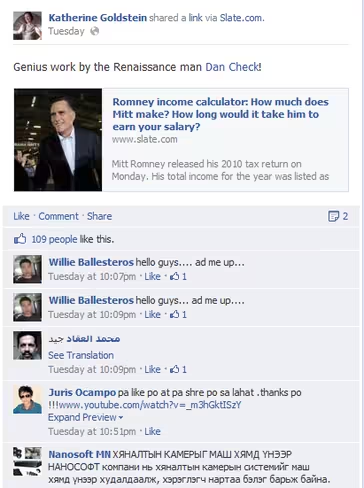
This is similar to the comment threads many journalists are seeing on their Facebook posts. There is some engagement — but there’s also a lot of irrelevant noise. Facebook disliked Romenesko’s use of the use of the word “spam” to describe these subscribers; Vadim Lavrusik, Facebook’s Journalist Program Manager, wrote in the comments of Romenesko’s post:
“Getting subscribers from other countries doesn’t mean they are “spammers”. Sure there is some spam, but I think that you need to realize that Facebook is a global platform. People find you based on their interests and who their friends are subscribing to. We are working on improving comments through quality filters, as sometimes they aren’t great because of language barriers of users who are subscribed, etc.”
Facebook says new subscribers come from social and interest-based discovery, but do you expect journalists who write about US media or tech to believe that their 50,000 new subscribers in the Middle East, many of whom don’t speak English, came through social channels and interests alone?
There is clearly a problem with how the recommendations engine works — it currently displays profiles at random. This is great for Facebook because it can tout how rapidly the Subscribe feature is growing. But it isn’t great for the journalists using Subscribe who now have to spend extra hours moderating their Facebook pages and deleting inappropriate comments, or shutting off comments altogether and sacrificing engagement with their readers.
Journalists want to have high quality conversations on Facebook, like they have on Twitter. If the majority of the comments they get have to be deleted, then Facebook Subscribe isn’t a useful news conversation tool – Twitter is more useful for that.
A part of the problem is how Facebook users interact with the Subscribe tool. Many of these users click the “Subscribe” button automatically when they see a suggestion with little knowledge of what they are subscribing to– this has resulted in many surprised journalists who are unsure of where their thousands of foreign subscribers came from or why they subscribed. Some users, however, go beyond and abuse the Subscribe feature and simply subscribe to hundreds, even thousands of users. For Subscribe to really be a useful tool for creating engagement, that problem has to be solved.
Another important point: Subscribe invites worse comments for women. Women get comments about appearances, marital status, and many vulgar messages that can’t even be repeated here. I have seen questionable, harassing, and sometimes downright offensive comments appear on the Facebook pages of journalists like Liz Heron, Mandy Jenkins, Kate Gardiner, and Lauren McCullough — some of whose experiences were described in this recent Poynter story. (“Hi will you have sex with me?” is a comment that regularly has happened to many women journalists). It is true that journalists of all genders are experiencing problems with offensive comments – but women get them in higher rates.
And now, a little of my own experience with Subscribe: I currently have over 82,000 Subscribers on Facebook. I opted in to use Subscribe in hopes that, like Twitter, I could tell people who are interested in my work or my writing to follow me and receive my updates. I did not promote my profile, but I was placed in the Subscribe suggestions engine and received 80,000 subscriptions. Many of these subscribers do not have an interest in my content or even speak English. Many leave spam comments on articles I post.
I have more Subscribers than I have followers on Twitter — but I also don’t have a spam problem on Twitter. While some of my subscribers post engaging comments, there are far more comments that must be deleted. I surveyed the profiles of 50 of my recent subscribers to see who they were and at least 3 of them had pornographic images as their profile pictures – I doubt that they are legitimate Facebook users, and even if they are, I’m not interested in having them as Subscribers.
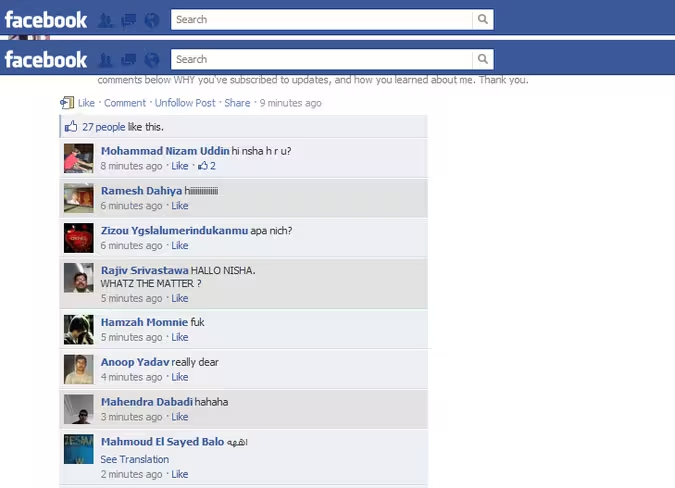
Facebook suggested journalists post a message asking subscribers to tell them a bit about themselves, so they can learn who their subscribers are and see that they are not so-called “spam”. Great idea! I did that. Here are the comments I got on that post. Maybe the word “spam” isn’t the best adjective, but the comments below definitely suggest there are problems with Subscribe.
Facebook has made a valiant effort to make its platform useful for journalists, but it’s time to admit that this tool isn’t working well. Subscribe has major problems that go beyond language barriers and cross-cultural communication.
For Subscribe to really work well, and to truly pose a threat to Twitter, here are three things that need to happen:
- The algorithm determining subscription suggestions has to be refined dramatically so that suggestions are targeted only at users who have shared/common interests, friends, or perhaps are fans of your media organization or fans of related interests. Many journalists aren’t ready for the onslaught of random users – and many are looking for high quality conversations with people who share their interests, like the ones they are able to have on Twitter
- Let journalists using Subscribe determine when, and if, they are placed in the Suggestions engine. Some may want to be in that engine. Some may want to promote their Facebook page via their website and other channels, but may not have a desire to gain 50,000 random subscribers in a week.
- Limit abuse of the tool. It’s clear that the issue is more with users who abuse the tool than with Facebook itself. So Facebook can place limitations around how users can use Subscribe. Currently Facebook allows users to Subscribe to up to 5,000 people, but I would highly recommended lowering those limits.
I’m looking forward to all the great engagement that Subscribe may eventually offer. But Facebook needs to address the problem and tell journalists what steps they will take to fix the Subscribe tool.
Journalists have flocked to Twitter over the past few years for its ability to offer engagement, ideas, and quality conversations. Right now, Facebook Subscribe can offer some quality conversations, but it also offers a whole lot of extra noise that has to be dealt with and isn’t going away.
Until then, that 320% increase in subscribers doesn’t mean anything. So for real conversations, I’m sticking to Twitter.
image credit: PUMPZA via shutterstock


I definitely agree with this post. I have always thought that if Facebook can really get "subscribe" going - it could rival Twitter.
www.thehungryandfoolish.com
- spam
- offensive
- disagree
- off topic
LikeThis is a very interesting conversation. I have many more followers on Facebook than I do on Twitter thanks to subscribe, but my experience is not all bad. Yes, there's spam. Yes, I've had to use the block button more than once and it's the first time I ever had to use it. But not everyone is a bot or porn peddler. There are absolutely issues with the recommendation engine, but I don't know that it's completely broken. I've made some new friends and I've posted asking people to tell me why they subscribed and most of the answers have been genuine. I'm not sure which Twitter y'all are using, but I've got plenty of spam problems on Twitter. It just looks different. I don't disagree with the base article, that there's work to be done to get the level of conversation on Facebook to match that of Twitter, but I think people might be a bit too hard on it. And I certainly am not a fan of grouping all the "spam" and useless chatter into one label called Middle Eastern people that don't speak English. I think that's offensive, even if it's how it appears.
- spam
- offensive
- disagree
- off topic
LikeMost of people ask me to be my friend instead subscribe to my feed.
I don't know who they are but they want to be friend with me. And I don't know why.
Friend 1 - Subscribe 0
- spam
- offensive
- disagree
- off topic
LikeI'm dealing with the "spam" problems... What is also not mentioned is the porn that comes with many of these subscribers. It's worse than porn followers on Twitter because these people have additional porn photos on their walls... which you have to visit to block them from your profile and have them reported. I love the potential of the subscription model... I look forward to it working better.One thing to note - I have put out a "who are you" post to my subscribers and found a handful of interesting international reasons why they chose to follow me.
- spam
- offensive
- disagree
- off topic
LikeAnd the winner is "Twitter" , Facebook need to come up with something 'really New'
- spam
- offensive
- disagree
- off topic
LikeHello,
I guess suggesting that all middle easterns dont deserve following any journalist from over the world is actually against internet rules. For sure spams can came from any otiose person who have one aim in life 'bothering people!'. Actually there is no tool on twitter that block users from specific countries to follow any journalist account so why suggesting that for facebook! The spam comments problem excists on twitter but it is less obvious cause the following thing isnt new, People dont use it just to try it wich is the case now for subscribe button on facebook. It needs just more time to let those otiose people get bored from the new toy they have then they will go to explore other galaxies.
In another part many people not only journalists were inconfortble about the last pravicy managment changes that facebook made, but manly because they didnt take the time to check properly all the possibilities offered for that. Some tips can help. For example, while editing your profile you can choose wich informations are availbe for public and wich are availble only for limitted people even specific ones from your firend list. That helps to protect your family and friends from getting thousands of friendship request from all over the world. You can also limite who can send you friend request to only friends of friends so you wont have spam requests. In another hand for a public face i guess the best way is just using even a facebook groupe or a facebook page that easier to manage as quickly you will see who are the actives people from those who follow you and the others actually wont bothr you.
I guess it is actually easier to use the tool you are used too cause both facebook and twitter have their advantages and disadvantages. It is a matter of wich tool you are more confortble with.
Safa Tliba, Algeria.
- spam
- offensive
- disagree
- off topic
LikeThanks for posting this. I am having the exact same experience. With about 45,000 subscribers, the experience is extremely spammy. Meanwhile my experience on G+ and Twitter remain much better because of the way they handle public conversations. They are not perfect, but Facebook didn't even think through that this would be a huge problem.
There are a couple of things Facebook can do to improve subscribe.
1. Namely, they need a moderation system for commenting. It's pretty simple, let anyone who has subscribe enabled decide which comments they want to appear on the profiles. Not everyone has time to moderate, but at the very least this will help us actually let people who post intelligent comments share, while keeping the spam out. It would be ideal if you could actually mark approved commenters so they can comment without needing moderation. Eventually this will build a solid group of public subscribers who can actually leave quality comments, versus the mess that is subscribe right now.
2. Let you choose which countries can subscribe to your account. This may be slightly racist and unfair, but I think all of us who have used subscribe can attest that the majority of spammy comments come from outside of North America and Europe. Culturally, the way people engage with social media in certain countries (ie Malaysia, Indonesia, India, etc) is very different.
3. Make it much easier to hide certain personal/friends information from the public. Ie -- one of my biggest problems with subscribe is that my 45,000 subscribers are now spamming my friends with friend requests. Yes, my mother gets a good handful of random men from India requesting her friendship. So do all of my 900 "real" friends, especially the female ones. I've had to turn off friend requests from anyone not connected to me through a friend, which has stunted the valuable growth of my friend network on Facebook. Meanwhile, my my friends are dealing with all the spam. I'm concerned they are all going to unfriend me because of this!
4. Let you post to public groups separately from your friends. I know this may seem like copying Google+'s circle feature too closely, but let's face it, this is necessary as most of us use Facebook for our personal conversations. The more you make subscribe like a separate account without users actually having to post through two different interfaces, the better the experience will be. Of course you could choose to post to public and friends, but that would be a choice, not a requirement.
If Facebook were to take the above four steps, I think subscribe would be a much, much better experience.
- spam
- offensive
- disagree
- off topic
LikeAdena DeMonte I guess many of your problems can be easily managed by facebook.
For your first problem if you can while having tens of thousands of subscribers manage to forbid or accept who can comments or not you can also block those persons so they can never see you on facebook again and for ever.
For the second point i guess it isnt about culture. More people live there so for sure we find more otiose people who just want to bother the others. But also i guess that mean there is more intersting people with different perspectives and points of view. It is actually a choice even block them all and that is actually against internet rules that aims to be a world wide communication tool, or deal with it and you can enlarge your own perspectives.
For the third point hiding personal information is actually a tool that excists you just check it in profile editing you can set for every information who can watch it dont make them public so subscribers wont see them.
Finally, actually if you hide your friend list wich is the same step as for hiding the personal informations you can implicitly separate your friend from ''the others''... In each post you share you just set who can see it the friend content will be hiden from the subscribers while the public will be seen by everyone even your friends but no one will know that they are your friend!
Hope I could help.
- spam
- offensive
- disagree
- off topic
LikeAdena DeMonte I'm little offended by seeing my country's name (India) on spammer list. Sadly its true. About 98% people (Male) join social networking site considering an AIO Marriage Portal, Porn Hub, Adult chat and jokes sharing platform, not to build up an identity. And the dramatic female profiles ensure their destiny. [ Brazilian profiles too, thats why Orkut was so popular in India and Brazil ] .
And so the most american kids, thinking themselves all Little Lady Gaga and post rubbish.
- spam
- offensive
- disagree
- off topic
LikeConversation from Facebook
Sometimes
yes
Then you're using it wrong Paolo. It's just a tool. If you think it's boring then find interesting people to follow or talk to. If nobody is talking to you then try to be more interesting.
I do agree with those interviewed in the article though, there is a lot of spam or irrelevant nonsense for those subscribers who do allow comments. Facebook staff must be sick of the 'timeline sucks, give me old Facebook back' comments in broken English (and correct English).
actually I find twitter totally useless....
I have been using it but if people turn off comments then what's the point. It's not like Twitter if you're just broadcasting and shows that Facebook completely fails to understand that social is a two way process.
Yes
Yes, subscribe to me :)
nope
no.