
On the Internet, we often traffic in hyperbole. It may seem extreme to say these founders of tech or tech-based companies have changed or even will change the world, but we live in world-changing times.
These 5 women and men aren’t the Mark Zuckerbergs, Steve Jobs or Evan Williams of the world but they still took everything we knew about the online world and turned it on its ear.
Whether it was changing how we shared our lives, how we communicated or how we sought to make a living, these founders took risks and came out on top. And because of that, the world we live in will never be the same.
Jessica Mah, inDinero
 Some of you might be scratching your heads about now, wondering who Jessica Mah is and why inDinero is so revolutionary.
inDinero is being called the Mint.com of small business and seems to be very well-received. But that’s not why Mah made this list.
Mah was born in 1990. A mere 21 years old, and she’s already on her fourth successful business since launching an eBay store when she was 13 years old.
She graduated high school at age 15 and while she was studying computer science at UC Berkeley, founded InternshipIN, a place for students to find internships with startups. While she was still an undergrad she built the prototype for inDinero with a UC Berkeley classmate. She’s the youngest tech founder on this list.
Mah can be held up as a role model for anyone. She proves you’re never too young to start a business – and to really succeed in business, not just because you’re a flash in the pan and had one good idea. She’s a female tech founder in a time when many bemoan the lack of female tech founders. And Mah’s just getting started.
Charles Best, DonorsChoose
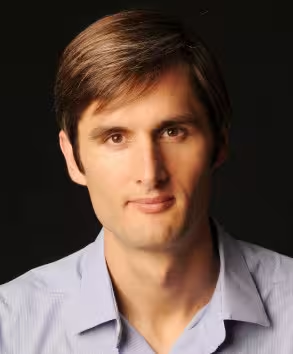 For five years, Charles Best was a history teacher in the Bronx. His first year on the job, he was frustrated by the fact that his fellow teachers would talk about the things they wished they could procure for their students – art supplies, books, science equipment and resources for field trips.
The teachers were spending their own money on basic supplies for the classroom and there was no way they’d ever find money in the budget for these extra expenses. Meanwhile, the parents were in no position to supply them either.
The idea for an “eBay for philanthropy” was born out of those teachers’ lounge conversations. He launched Donors Choose out his classroom for the first few years. Then a cold call to Jonathan Alter of Newsweek paid off. His article caught the eye of Oprah and things exploded from there.
Best is quick to point out that teachers aren’t just posting wish lists on his site – they’re posting educational projects they’d like to do with their students, and the list of resources they need to complete them.
In a world where education is one of the biggest factors for success later in life, the ability of teachers in poorer school districts across the nation to not be limited by budgets is revolutionary.
Best probably became a teacher in the Bronx to make a difference. He has, but for a lot more students than he probably ever imagined he would reach.
Alexa Hirschfeld, Paperless Post
 Alexa Hirschfeld had two years in a comfy job at CBS Evening News (as comfortable a job as any in old-school media can be) before jumping into the entrepreneurial waters with her brother and starting Paperless Post.
Paperless Post proved you don’t have to be revolutionary to create a revolution. It also proved you can take an online product people are using for free, make it better and then charge people to use it.
Evite and other free invitation sites had been around for a while before Paperless Post made its debut. But, man, were they ugly. They were free because they were ad-supported. And who would pay for an online invitation business anyhow?
Lots of people, it turns out.
People keep saying that traditional media can’t start charging for its products online or via mobile apps; no one’s going to buy the cow when they can get the milk for free, after all.
Hirschfeld’s company proves that to be a lie. If your product is significantly better than the free alternative, there are people who will happily pay.
Greg Tseng, Tagged
 Let’s say you found a social network and your chief competitor turns out to be Facebook. As Facebook grows and grows and knocks MySpace off its perch while smaller networks are shrinking and dying on the vine, what do you do?
If you’re Greg Tseng, you pivot.
Tseng had a large user base of people making connections with people they didn’t know. He decided to change his focus from social networking to social discovery and was soon on the rise again.
Experian Hitwise now ranks Tagged.com as the No. 5 social networking site, after Facebook, YouTube, Twitter and Yahoo! Answers. It’s debatable whether YouTube and Yahoo! Answers actually are social networks. Nos. 6 through 10 include LinkedIn, MySpace, MyYearbook, Google+ and Pinterest.
In the past year, Tagged gobbled up instant messaging client Digsby, information service TopicMarks and former competitor hi5. It started the year with 50 employees and ended with 200.
Not every company can pivot gracefully. Gowalla tried and ended up a footnote in the history of geolocation, bought out by Facebook for its staff. Tagged showed there was room in the social networking space for one more, and carved out its own niche. Watch our video interview with Tseng here.
Eileen Gittins, Blurb
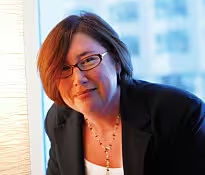 It’s not every day you get the chance to save an industry. While it’s still a bit too soon to be writing a eulogy for book publishing, it’s not too soon to start thinking about it.
We’re not talking about the rise of the Kindle, Nook and tablets as being saviors for authors who can still get their tomes out, electronically, to their readers. We’re talking about actual ink on paper, hardcover books.
Gittins worked for Kodak and helped found several companies, including Personify. Her roots were in photography, though, and she set about taking portraits of 40 people she’d built companies with. She wanted to give them an elegant coffee-table-quality book of the images as a keepsake.
Turns out, you couldn’t do that. Book printers weren’t set up to do small runs and self-publishing online was nowhere near the quality of the coffee table book.
So despite many people thinking she must be just a little bit out of her mind, she pressed forward and founded Blurb, where people can order even just one copy of their book if they want. Many people have democratized the Web in the past decade, but none has democratized print. Except Gittins, who may have just saved an industry at the same time.
Who are your favorite founders who are changing the world? Let us know in the comments.
Get the TNW newsletter
Get the most important tech news in your inbox each week.


