
I wanted an iPhone when it first came out. Really, really badly.
It’s not that I couldn’t afford it; money wasn’t an issue. I also had a phone that was in sore need of replacing, so a smartphone was the next logical purchase. I already immersed my household in Apple gear, so an iPhone was the best choice. But I had no way to get one…because Canada didn’t have it. And we never did get the first iPhone.
While that could be seen as a blessing in disguise, considering that us Canucks were spared a first generation model, it makes me wonder why in the world we don’t get technology that is available right below us. Especially when much of the technology we want comes from right below us.
“I think Canadians have been sold a bill of goods about why it takes so long,” says Jesse Brown, MacLean’s columnist and host of TVO’s Search Engine. “We’ve sort have been told that ‘it’s a smaller market’ and ‘it’s less important’ — and they’ll get around to us. They’re sort of appealing to our Canadian sense of inferiority, patience and politeness.”
Brown says the reality is that there are powerful, entrenched interests that have various projectionist relationships with the government, making it difficult for American companies to do business in Canada. Basically, the reason the iPhone finally came to Canada was because it got the point where it was going to impossible to deny Canadians the hardware; the telecom companies were forced to bring it in. But at least they could attempt to profit from that.
In terms of getting technology later being a blessing in disguise, Brown disagrees.
“(That’s) a bit of a paternal attitude,” says Brown. “Its not just about a sense of entitlement…the iPhone launched an industry of app development. It was a real innovation engine for all kinds of developers who make stuff for it. I don’t know how you can make stuff for it if you don’t have one.”
Interestingly, Canada has the highest iOS market share in the world, and this wasn’t lost on a group of developers south of the border. The developers of Matchbook, a recently released app that allows users to bookmark and organize places they’ve visited, decided to use Canada as the testing ground for the app. It’s that kind of attention (not to mention foresight) that should encourage hardware companies to think twice about ignoring Canada during a product’s initial rollout — or ignoring Canada altogether.
While hardware is one aspect of the equation, digital content and new media is another large part. A very large — and very broken — part.
Canadians can watch shows like The Colbert Report on CTV affiliates, a basic cable offering. But when they try to watch exclusive Comedy Central content associated with the show, they are halted at the point of entry with the following message:
I don’t subscribe to The Comedy Network, and I’m not really a fan of their website. I want to watch the content where I want to watch it. Website appearance aside, I would subscribe to the station — I’m a big fan of comedy. But it is only available from my cable subscriber as part of a premium cable package that includes 20+ other stations I have no intention of watching.

Diane Wild, the woman behind TV, eh?, a website and podcast that focuses on Canadian content explains why the above message appears on any computer screen based in Canada when they try to watch a video from Comedy Central.
“In general, what happens is the Canadian network has to buy the rights from whoever owns it,” Wild explains. “The broadcast rights are separated…the television rights versus the web rights. Sometimes broadcasters only buy the television rights and not the web rights.”
Wild goes on to say that if the Canadian broadcaster hasn’t bought the web rights, then they can’t show the content. That’s when geo-blocking comes in. The geo-blocking basically means websites recognize what country the computer is trying to access the content from, and doesn’t allow access to the content if the computer is transmitting from an unapproved region.
Sites such as Hulu don’t work here, either, meaning that if Canadians really want to watch shows online using that service, they have to attempt to circumvent the region blocking. Some software allows this (such as Hotspot Shield for the Mac), but content providers are betting that most Canadians won’t bother. And they seem to be right…for now.
“I can’t see it,” says Wild about Hulu coming to Canada. “If Hulu decides that they want to go into Canada that would be great. But then they would have to negotiate with not only the American partners but the Canadian networks that own the rights to broadcast those shows. So it becomes this really complicated labyrinth and the Canadian population and the money they can get from us probably doesn’t justify that amount of effort.”
When Netflix entered Canada back in September of last year, the content available paled in comparison to its American counterpart. While the library has grown considerably over the past few months…it has a long way to go before hitting the level of variety that Netflix offers in the States.
Some would suggest that if Canada begins to adopt more American values in terms of how they handle content, then Canadian consumers could see improved digital content access. Aligning copyright laws with the US is one of these items on the table. That idea is a fallacy, suggests Russell McOrmond, an Ottawa-based copyright activist.
“Other than the digital locks provisions, that the Americans have and we don’t,” says McOrmond, ”pretty much every aspect of Canadian copyright law is stronger than the American copyright law.”
“There are other issues like CanCon (Canadian content) and all those sorts of things, but when it comes to copyright the U.S. law is weaker.”
McOrmond also says that those who suggest that any sort of harmonization would help Canadians get better access to digital content have a misunderstanding of the laws in both countries pertaining to the issue. He adds that he’d be all for some aspects of harmonization, as Canada’s law doesn’t allow for Fair Use of content.
“VCRs…it would be nice to have legal in Canada, finally,” he adds.
Digital content isn’t completely unavailable to Canadians that can’t get it through their cable providers. Torrent sites are becoming easier to use and are filled with content — both legal and not-so-legal — to download by users. Andrew Currie, who operates the website Open attitude, explains why some illegal torrents are often superior to digital media purchased legally.
“No DRM. No geographical restrictions. Usually users can get something faster and it’s a better product,” he says.
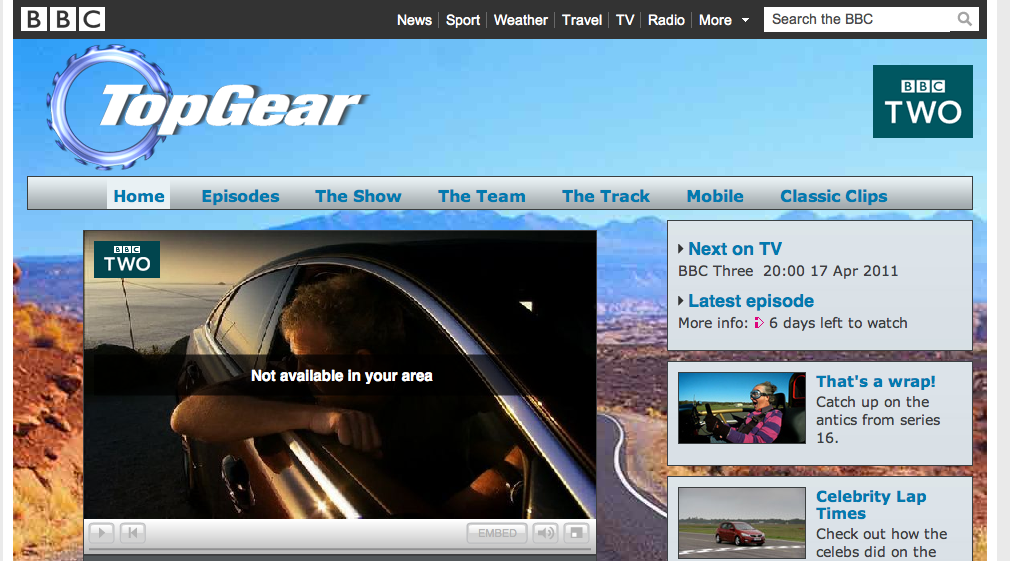
Currie offers the British show top Gear as the best example of this. It is on in the UK on Sunday evenings, so Currie is able to get a wide variety of versions of the show from a site that’s purely dedicated to hosting torrents of the program. If Currie were to use “legal” means to watch the episodes as they aired in Canada, he’d have to order a package of channels from his local cable subscriber — channels he never watches — all of which cost more. He’d also get it much later than he does by watching a torrent of the show — much, much later. (Season 16 of Top Gear has already finished airing in the UK; a visit to the BBC Canada website shows that Season 15 is the “newest” season available here.)
By the way, if you try to watch anything about Top Gear at the BBC website from a Canada-based computing device, you’ll get a familiar screen:
Even Wild, who relies on a steady stream of CanCon in order to contribute to TV, eh? is strongly considering cutting cable from her life.
“I don’t think I’m getting the value from cable that I could,” Wild explains. “It would certainly be a sacrifice — or I would have to do…some non-legal ways to find some of the content that I want.”
That likely means using torrent sites for Wild. And while she’d likely have to resort to downloading content illegally via these sites, the misconception that all torrents are illegal irks Currie.
“I don’t want people to have the idea that bit torrent, by default, is an illegal activity,” Currie explains. “For example, there’s a TV series called Pioneer One that is being distributed through Vodo.net, which is a torrent distribution site — and a perfectly legal one.”
Currie asserts that Canadians really shouldn’t be envious about the lack of content, because there’s already too much of it.
“Entertainment — what old media people are trying to sell us — it’s increasingly like air. It’s everywhere you look. So somebody who…is producing a TV show and get eyeballs to watch it has to deal with the fact that there are an increasing number of people that are doing it for free.”
Wild believes that if Canadian broadcasters viewed CanCon as a blessing instead of a curse, they could actually win over more viewers rather than driving them away to alternate sources of American programming.
“I don’t understand the resistance to it (Canadian content),” says Wild, whose work her website deals with Canada’s home-brewed content. The resistance to putting Canadian content on — they’ve got all kinds of excuses. But if they fostered that they’d be in a much better position.”
“I think it’s sad that we need Canadian content laws in order for them to want to have their own original content,” Wild continues.”We’ve got protectionism for these companies and yet they are so resistant to have protection for original Canadian content. It’s a bit hypocritical.”
Jesse Brown agrees.
“I think it’s a real travesty what’s happened with the whole program,” Brown says. “The whole idea has sort of been perverted — the idea is that we want to tell Canadian stories but if we don’t regulate it then it’s not going to happen. Think about that for second: what’s the most interesting Canadian story? Is it some Entertainment Tonight Canada thing or is it what’s going on in a place like Fort McMurray? The stories there (Fort McMurray) are fascinating. There’s no TV show about it. If I wanted to find out about what’s going on in Fort McMurray right now I’d have to go to YouTube where Canadians — for free — are making their own CanCon. Even the CBC want to be like an American, frothy, television network that does stuff that, in many instances, aspires to be American entertainment. It’s not even trying to something different and interesting.”
Brown cut the cord to his cable TV subscription last month, relying on a form of pseudo-piracy to obtain his media. But he doesn’t use bit torrent sites, per se.
He pays a monthly fee to Giganews that gives him access to Usenet (what computer-savvy people used to use all the time for networking online), which delivers him the video files he chooses to download at breakneck speed. Brown’s article in Toronto Life drew the ire of broadcasters and television producers across Canada, as he exposed himself as a pirate that has found a means to get his content elsewhere. He concedes that those means are questionable, and a month into going “cable-free”, he’s heard from both admirers and detractors.
“It’s the funniest thing,” Brown admits, “because on the one hand I was wondering if I was going to be ostracized, I was wondering if the cops were going to show up at my doorstep, if I’m going to be losing my integrity as a journalist and do I really want to admit this. And on the other hand, it’s like admitting that you eat a few grapes in the supermarket before you buy them. It’s not all that uncommon of a thing. I know people who don’t pirate — but their kids do.”
As for the response he’s received, Brown takes it all — the praise and the browbeating — in stride.
“It’s been a fun experience to see half the people — my readers and listeners — be like, ‘Yeah, we kinda figured,’ to the other half — the president of ACTRA, the producers of Degrassi — slagging me as a thief.”
(Brown lets it be known to those slagging him that he has never pirated any of their content.)
He also believes that the reason more Canadians don’t obtain their content as he does is it’s not terribly convenient or easy. Yet.
“It won’t be forever. That’s where business opportunities still exist for legitimate services.”
One potential opportunity Brown thinks has legs is that third-party internet service providers (like TekSavvy, for example) will begin to offer a paid option that will make it look as if all of a user’s traffic has an American IP address. Brown believes a service like that could really allow the smaller providers the market share to take on the larger providers like Rogers and Shaw.
Our country’s rules and regulations seem to be the real barrier for Canadians’ access to digital content that they’d like to have but can’t. Whether it’s through roadblocks put up by special interest and government or an unwillingness for those outside of Canada’s borders to spend the time and effort to get devices and content to the Canadian public, all of that has to do with how much those barriers aren’t being challenged by those that really want what they’re being denied. Only a few seem to want to do anything about it — and even fewer actually are.
It’s the “canaries in a coal mine” — as McOrmond calls those Canadians that are well-versed in how digital content works — that need to step up and make their concerns heard if they want to get access to the content that they want now rather than later.
“I think everybody sits around and complains but no one figures out why,” suggests McOrmond, who is based in the nation’s capital. “The problems are coming from inside Canada. We are actively refusing content. CanCon rules should not apply to retail. Why should CanCon rules apply to Netflix but not to WalMart? It’s these silly rules.”
It’s a good thing we’ve got an election coming up, where voices can be heard and changes to what we get and how we get it can start to happen.
Then again, our recent voter turnouts haven’t exactly been the envy of other countries’ either.
Get the TNW newsletter
Get the most important tech news in your inbox each week.