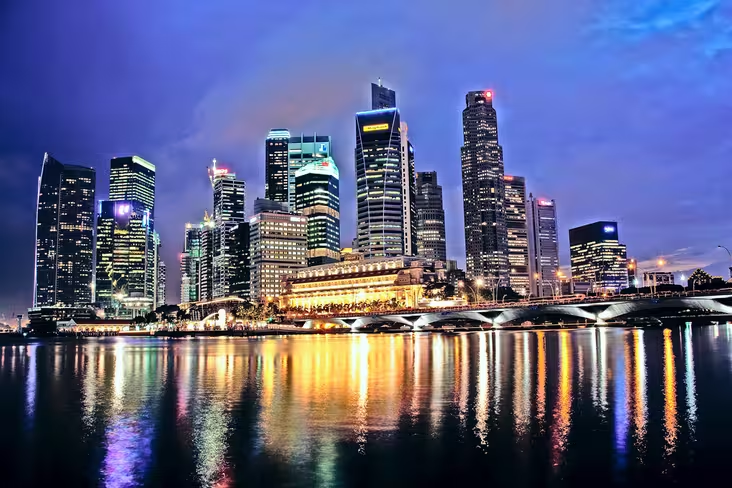
Singapore has been on the receiving end of some honest but valuable feedback from Apple co-founder Steve Wozniak who claimed that a company like Apple could not emerge from the country, according to the Wall Street Journal.
Woz, as he is know, claimed that Singapore carefully managed society, where “bad behavior is not tolerated” and “people are not taught to think for themselves”, puts Singapore at a distinct disadvantage when it comes to encouraging and nurturing creative talent.
The Apple veteran, who was the company’s first employee, told the BBC (in an interview that is ironically not available in many parts of Asia):
Look at structured societies like Singapore where bad behavior is not tolerated [and] you are extremely punished. Where are the creative people? Where are the great artists? Where are the great musicians? Where are the great writers?
The US has historically held a dominant position in bringing new technology and innovation to market thanks to many factors that include availability of funding, greater culture of startups, size of population and more. For a country whose population is lower than New York, building a firm like Apple is a big, big ask.
A great many of the world’s top technology firms have regional office bases in Singapore. Google, Facebook, LinkedIn, PayPal, Microsoft and others have strong native and expat workforces in the country, so it is clear that Singapore has talent in the country, but what about emerging ideas and people?
I’ve spent most of this week in Singapore where I’ve been impressed by the use of everyday technology (you can easily hail a cab by SMS or an app, and pay cashless, for example) and a number of companies — large and small, established and starting out — that I met during my time in the country.
There is no doubt that some parts of Asian culture can make risk taking, the first step of any new company, difficult, and that applies to more countries than just Singapore. However there are people doing innovative things across Asia but the scale of Singapore — its finances, population, etc — makes any direct comparison with the US, UK or other markets unfair.
In reality, the issue of innovation and companies in Asia is a hugely complicated one with a great many factors, including availability of funding, captive audience, culture and other issues, so to pick just one out as key is difficult.
The Next Web‘s recent interview with startup incubator JFDI threw some interesting light on the issue of growing business in Asia. As JFDI CEO Hugh Mason told us, there is plenty of talent in Singapore and the region at large, but a lot of the time encouragement and guidance is needed to help bring innovation, products and ideas forward.
Wozniak is working with the Singapore government to provide such guidance as the authorities look to encourage greater innovation and tech industry involvement in Singapore. While he may be able to help shape policy, it remains to be seen how other issues — such as culture — might be, or even need to be, addressed to help creativity in Singapore blossom.
What do you think? Do Singapore’s rules and regulations restrict the creative freedom of its population, or is the reason behind lack of Asian startups and innovators, more complicated? Let us know your thoughts in the comments section below.


@jonrussell thank you for the honour of a citation in the same article as an Apple co-founder :)
Over the last ten weeks, my colleagues and our partners from SingTel Group staged six 'Startup Weekend' events in Asia Pacific Cities. In total that involved over 1,200 people forming teams to create 150 prototype businesses in 54 hours. We will be welcoming six or seven of those teams to our bootcamp starting in January.
It was fascinating to see people from countries as diverse as Australia, India and Singapore being creative against the clock. The Aussies drank by far the most beer, the folk in Manila laughed the most and the Singaporeans put forward far more ideas per attendee than any other city! In fact 120 local people stood up in front of a crowd they had never met before and pitched an idea in one for a minute. They did it with humour, intelligence and originality. Their experience is documented here: http://youtu.be/XXbfTFNsZKk
In the five years I've lived in Singapore I have seen plenty of creativity. That's true, even though the folk who are most celebrated tend to be scholars who had the least chance to play and practice coming up with ideas as kids because they were working so hard for their exams. Today they are the senior policy-makers in government. They know that Singapore must develop its 'Knowledge Economy' and, to be valuable, it has to do more than merely reproduce other peoples' ideas. I hear Singapore's elite saying, time and again, that its economic future depends on innovation. Perhaps it was once true but I don't think the inhibition on creativity comes top-down any more, as Woz suggests.
Rather, I wonder if a focus on science and business that was once appropriate to nation-building has become baked in to parts of the national psyche in ways that are no longer helpful. In other words, maybe the inhibition is bottom-up, not top-down.
For example, last week I met a young woman (now 19) who was caned as a child every time her parents caught her drawing pictures. She and her sister were only permitted to study business at University. Perhaps it's because I'm an outsider that Singaporeans want to tell me stories like this. I hear them so often that I do wonder if there are some deep-rooted cultural issues that might condition Singaporeans to hold back on expressing themselves.
I am an outsider so I don't make any judgement on that. What I do observe is that, given the right setting and the chance to practice without fear of failure, Singaporeans seem just as creative as any other nation. I have a hunch that the country will start to realize and celebrate that with all the change that seems to be happening just now. It's a privilege to be here at a time when ordinary local people are starting to put forward their ideas with confidence.
- spam
- offensive
- disagree
- off topic
LikeAs I said on other sites, Singapore is "not allowing people to express their creativity", they just want "creativity to be expressed at the right place and the right time". Maybe creativity may be restrained in certain aspects, but as time moves on, the government would realise the potential and eventually open up. Singapore only wants companies to not badmouth religions or races or political parties, which could be done so easily.
In fact, it's very easy to start businesses in Singapore. I live in Singapore, I could see several kids having a garage sale (an actual one) and no one restricted it or anything. You see buskers on the street and there was recently that Buskers Festival at Sentosa the other day. Money is invested into expressing creativity, so Singapore's actually encouraging this.
Even advertisements sometimes badmouth each other. I recall an ad by a government-run company criticising another government-run company. It was approved anyhow.
It's just that Singaporeans sometimes have an "I don't give a care" mindset, not the "I don't want to be sued/charged/jailed" mindset.
- spam
- offensive
- disagree
- off topic
LikeBeing a young Singaporean myself, i do agree to a certain extent these rules do constrain our creativity thoughts at times. As much as we might be able to harness on our surrounding for inspiration, there are things that may have been voided due to the bans. However, in time to come there might be a few active and creativity souls out there to break this barrier and lead the pioneer batch of innovators in Singapore.
- spam
- offensive
- disagree
- off topic
LikeI'm not sure you can build firm like Apple in America anymore. The tax code is punitive on small businesses, the Business culture is aimed at Finance and Insurance not technical innovation, and ROI requirements kill any high risk activity.
- spam
- offensive
- disagree
- off topic
LikeThe jokes on you Woz! People in the USA are not exactly taught to think for themselves either. Hove you looked at the political leanings of your average university professor? It's like 90% liberal and they love nothing more than creating scads of young 'progressives'. Next.
- spam
- offensive
- disagree
- off topic
Likepemullen The first requirement for creativity is a liberal outlook.
Here is the liberal credo for you.
"I do not agree with you. However, I would fight for your rights to differ from me"
Ability to tolerate and appreciate divergent and seemingly contradictory views is the cornerstone of liberalism. The exact opposite of liberalism is the "yearning for conformity" where lies the seed for all regressive movements like fascism and conservatism. Fascism differs from conservatism in that it seeks to change the society to a mythical glorious past where everything was perfect (while in reality hugely flawed).
Creativity flowers in liberal settings not where every body wants to drink the same brand of tea!
- spam
- offensive
- disagree
- off topic
LikeI think it's a shallow observation often done by visitors. If that was true then there would be no creative thai advertising spots or chinese artists. Yet there are plenty. Where is the german Apple like startup? It's a fairly open society in the regards that Woz talks about. Or french, italian?
Also is he pitching to SG's repressive gvmt how more dissent people will enable creativity and innovation? Bit ironic isn't it?
- spam
- offensive
- disagree
- off topic
LikeThere is absolutely no question that this is true. I have done several writing gigs in Singapore and the place is full of people worn down by mild fears and obligation to strange state sponsored priorities. While you can shop, see films, and eat, there is a stultifying blandness and lack of energy to the place. It differs fundamentally from Hong Kong, Shanghai, even Tokyo in its desire to present a Disneyfied appearance not just in the cleanliness but in peoples' minds.
- spam
- offensive
- disagree
- off topic
LikeRobert J. Crawford I thought it was just the heat from being on the equator.
- spam
- offensive
- disagree
- off topic
LikeWe (Tigerspike) are setting up our Innovation Lab in Singapore in January 2012. The time for criticism of Singapore for not innovating is over.
- spam
- offensive
- disagree
- off topic
LikeSingapore's infrastructure wouldn't emerge in countries like the US especially as quickly as it did - and there's beauty in that. We are a very young and in years to come, it will find the right balance - it's already taking the steps. Creative was a great company and I think their demise is unfortunate.
I think the real issue isn't that there isn't talent, but there's no real system or understanding of how to grow and maintain start ups in those fields - thus Singaporeans have to look at foreigners - and that just doesn't fit into this mold. If that makes sense. I think the flip side is, there are places in America where Apple couldn't emerge.
- spam
- offensive
- disagree
- off topic
LikeWoz, will love to see you visiting Egypt. we need this kind of criticism.
- spam
- offensive
- disagree
- off topic
LikeI think there's a typo in the sentence - "building a firm like Apple is a big, big ask." - that word should be Task.
- spam
- offensive
- disagree
- off topic
Likesuhail Pretty sure it's right. It depends on the meaning. Is he talking about the actual act of building such a firm? If so, you are correct. But I think he is saying that trying to build such a firm would be a huge demand given the culture, in which case it's correct as it stands.
- spam
- offensive
- disagree
- off topic
LikeConversation from Twitter
haruharutnk 334万分の1!
aaron01437 Nice article.
liantze valid points from woz
soulkipper I should've added "...and in M'sia?" :p
Evyfindstheway False comparison isn't it? Singapore only has a few million people. It does pretty well from a small base like that...
rhyswesley I agree. There are a lot more factors than population. Education, culture...etc I'm writing a blog about #creativity. Stay tune!
Evyfindstheway Cool, look forward to it!
earboz tres interessant, merci bro' cc kiezin
jamiekoa The creativity? It's with jamiekoa and @ssowy!
Conversation from Facebook
Having grown up in singapore and now living overseas, woz is right on the money!
After travelling to different countries, i gotta agree... But, from another perspective, managing a country to excel is not easy either...
ahhhhhhhhhhh WHY BOTHER GUYS EVERYONE HAS VARYING OPINIONS....
Woz is not all together correct, I have lived in Singapore for 14 years, its a smaller market than the US, which hasnt allowed for the kinds of growth Apple and Google have had, seed funding for example. If Woz looks back at how they ripped off Creative on the Ipod and ask themselves where would they be without that?