
The Next Web

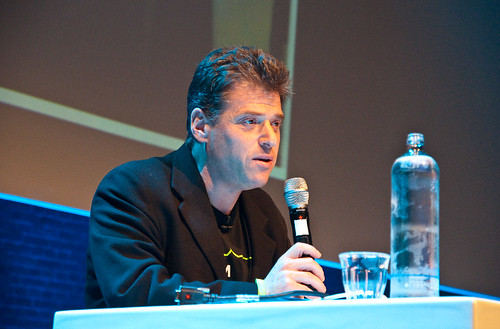
Andrew Keen “Web 2.0 is dead, long live Twitter”

Moderator and conference organizer Boris Veldhuijzen van Zanten asked Andrew Keen to address the following question in his keynote: Why do you love the web?

Note: written from the (I/we) point of Andrew Keen.
The Next Web

We are living in a critical moment in history. The post-industrial is clearly different from the industrial age. Technology is not interesting because we can use Google but because it is the midwife of change and the cause of consequence of that change. Our history is based on places like the Westergasfabriek where the conference is taking place. We are in a new age which is born by the internet.

Johannes Vermeer - Woman in Blue Reading a Letter

Johannes Vermeer - Woman in Blue Reading a Letter

Intimate media
Why I love this woman so much is because it’s so intimate that it manifests media at its best. The woman is reading, concentrating, it is an essential manifestation of media. She has emerged herself in the letter, that is the best kind of media. Twitter may be real-time but this Vermeer picture is both real-life and real-time media. It doesn’t have a business model but it nonetheless reflects the two core features of successful media: intimacy and trust. It is transparent and profoundly deep. When we look at it we are thinking: who is she, what is she reading?

Media has to change. Technology has resulted in power, not to the people but to the individuals. “WE ARE INDIVIDUALS” (Jeff Jarvis) is not so much an ideological statement as it is a core sociological and anthropological statement. The end of the industrial revolution is the shift of power from the institution to the individual. The new age is the age of the isolated and empowered individual. This is also the paradox because the individual is no longer able to concentrate and lives in a virtual reality. This is a new revolutionary, transformation age where we are the product. The fact that we are individuals is both the power and the paradox of the individual age.

The question then becomes how do we make sense of this, how do we transform meaning to make it work? The Dutch and people in Amsterdam are experts of transformations. The conference venue, the gasworks (Westergasfabriek) is reinvented as a meeting place. Amsterdam has industrialized late but it industrialized successful. It is no coincidence we are on the edge of reinvention.

So what has to happen to media in this new age? We need trust, we need to do away with anonymity and we need intimacy. Human beings are good at sending messages.Technology may have changed but the basic nature of communication hasn’t changed. My biggest concern is that the change was not going to be successful, that the old world was being replaced and swept away. Web 2.0 doesn’t work, it’s flawed, it doesn’t create revenue. If we want to recreate the newspapers, they’re fucked. We want reliable information but also intimacy in the new age of the individual. We need to reinvent a medium which gets beyond amateurs. Web 2.0 is finished. Even Techcrunch, the leading cheerleader of the Web 2.0 industry, has come to the conclusion that sites like YouTube don’t create revenue, it doesn’t work.

I am deeply encouraged by Twitter, so encouraged that I ask you to follow me @ajkeen – This is the future of individual media in the age of the individual. On the one hand it is inspiring to build your own broadcast network but it is also worrying because it duplicates inequality. The mass age was egalitarian, the individual age is unequal. The future is the age in which the individuals become brands. We need technology to enable these brands, people with talents, on the network. Twitter is the beginning enabling technology.

Web 2.0 is dead and Twitter is the symptom. It is the end of web2 .0, it represents a final nail in the coffin of business models built out of amateur content. We are entering a time with a new kind of professionalism and expertise. The new age of the individual which truly empowers smart talented people.


  • To Andrew Keen:
    I get the sense everyday that we as individuals are becoming brands in a way, are more isolated in spite of all the social exchange in the sense that we want to control too many things from our own virtual reality. Of course to become a brand in the network you need to stand out a little bit. What's going to happen with those that don't stand out? Are they going to some kind of black hole? That is, if you are not able to become a brand, to triumph as an individual, does that mean you are no good? I agree that the trend is certain but where does it all lead to. I like your idea around Twitter and the end of Web 2.0. I don't know is that can be proclaimed and I don't think it's 100% accurate but it is an interesting approach after all. So according to the text, it's the generation of revenue what makes it valid or not. The never ending story of money, companies, capitalism and the alienation of the individual? What else do we have? Well, I guess we have to accept it then. Do we? On the other hand, we still make use of Web 2.0 principles and thanks to that Twitter exists and feeds on that so I don't see how can it be finally declared as dead. All of these coined words are rather inexact, web 2.0, web 3.0. The presence of marketeers behind these trends makes it all more confusing and trivial. But in all I enjoyed the visionary approach and specially your analysis of the image and the part where you say the letter is the best kind of media.
  • Does Andrew Keen actually understand what Web 2.0 is? Given 'Web 2.0' is actually about openness, participation and collaboration, and given Twitter enables all three phenomenon, this seems a rather oxymoronic statement.
  • BobCFC
    I'd say that's a Monty Python quote not JJ

    http://www.youtube.com/watch?v=2T1LIrzsgqA
  • M1chel
    Hi, I'm a student of communication sciences and an internet lover which lead me to write a bachelor thesis on the evolution and cultural affection of internet in the present society. I'm currently trying to get all the ideas in words and I really love what you wrote in this article. it gives me a new perspective on the last step we reached or we are gonna reach.
    I mean, I feel it's an unusual and therefore fascinating approach and I need to think about it, but so far I came to the conclusion that what you say about branding ourselves it's true. And web 2.0 is definitely going to evolve in something new. it's an internet's paradigm that dictates such a fast and endless evolution.
    However I think it's wrong to say that web 2.0 failed. it's somehow meaningless to consider it could fail or succed. which are the parameters to judge its results? the fact that is gonna evolve and be replaced? I think it's more of a natural path. "web 2.0", as we call it, played a fundamental role in a revolution that involved much more then few websites. you say it your self mentioning for instance newspaper's decline. it had a life and a purpose that may got completed and we're maybe ready to the next step that you're interestingly proposing here. I say then, that it was really useful and it succeded.
    Something else I need to think about is the actual new way branding ourself could open or not. I do agree with this movement right now, there are niche of well trusted indivuals that gained by merits their subscribers and they are solving a big issue of web 2.0: taking as an exemple news industry again, mainstream media lost their followers and fame coz we couldn't trust'em anymore. they were lead by companies and corporates, they did stuff, they didn't said stuff, the made up stuff and we knew everything thanks to internet and web 2.0 which simultaneously was the new era of newsmaking as it could broke the barriers of old agencies: they were gatekeepers deciding what to show and provide, while through blogging and indipendent media everything was shown and the users decided what to pick. plus no more filters between me and the news. or at least the minimum possible. The only problem was still trust. can we trust a little No-one telling me stuff? intimacy was not enough yet. instead it seems to become enough now where thre's an individual taking the besto of two worlds: the intimacy of a 1 real person and the professionalism of an institution. still we have to trust this few person but it's a step ahead. or is it not? one of the pro of web 2.0 was also the number of referencies (each personals) that could make an info trustable. now instead we're moving back to an oligarchy. but maybe that's just a problem too speific for newsmaking.
    What I think must be cleared of this "branding individuals" concept is that you consider the whole thing from the point of view of revenues and product or marketing success. This is also why you say web 2.0 was failing probably. But revenues is just not a target, an aim that embraces the will of all users. wether you intend both revenue as money and popularity. For those who do then yes, I think you're right and twitter is cutting it. for the rest, wich I believe are a vast majority, twitter isn't something that really affect them. many users see internet as a reference tool for information and right now we're good and twitter doesn't add anything. most of users think of internet as a way of keeping in touch and being "online" as we are effectively individualizing the society as never before. for them twitter is effective as a new tool of communication, but it's not much other then that. I don't feel or I don't see yet a will that goes beyond being in a net of connection and communication. I think this "brandind of individuals" is happening but it's relevant only for few professional.
  • M Vetter
    M1chel, it is interesting to hear a young perspective and hear someone struggle to draw the cultural and social significance from the Internet. I think arguing the merits of different technologies (Web 2.0, twitter, etc.)--which has lead to significant advances vs. which has lead to further degradation of culture--is an unfruitful pursuit. I think what you say about "branding of individuals" being important but not for revenue sake it interesting. As a marketer, I regard brands as valuable because they help organizations establish consistent, credible, remarkable, desirable reputations that people will pay them for. At a personal level, you mention the few professionals that are benefiting form the "branding of the individual", but it isn't only professionals.

    Any idiot committed enough to invite thousands of people to watch him and crawl around from site to site, following and posting can establish a brand. Just look at the hot gossip columnist turned celebradork. Talentless, irrelevant and yet exposed, connected, linked, followed, hit, trafficked, etc. Determination has always allow individuals to rise to the surface whether the platform or environment was actual reality or virtual reality.

    But the profit motive and the profit reality always come back to me. I cannot believe the amount of resource that is poured into the Internet every day on the promise of profit or money or meaning that can be turned in to money. I agree that some aren't motivated by it and they can find a following with no regard for making money. Popularity is a currency all its own. But, one day, will the Internet get a black screen, like our debt clock that says, "Times up. There is no longer enough money to support activity that does not produce value or currency. The Internet will remain off, until sufficient currency is generated to turn it back on." Will it?
blog comments powered by Disqus


TwitterCounter