
Entrepreneurship is often thought of as an art, a skill you hone over time – but is there a science to it too? That’s what The Startup Genome Report, a new in-depth study, set out to discover.
Based on information submitted by over 650 Internet startups, the report sets out clear stages of a startup’s development and identifies distinct types of companies. The project aims to make this data available widely in order to increase the success rate of startups and accelerate pace of innovation around the world.
Cracking the startup ‘genetic code’
The Startup Genome Report is the work of three men – Bjoern Lasse Herrmann, Max Marmer and Ron Berman – who set out to ‘crack the code’ behind success or failure amongst Internet startups. The team is also responsible for the Blackbox accelerator and the Blackbox Mansion, which we recently profiled as a “Playboy mansion for geeks“. So, what prompted this new, in-depth study? “Max and I came together in December to find a scalable way to accelerate startups,” explains Herrmann. “We were inspired by the global explosion of entrepreneurship and its positive impact.”
“The Kauffman foundation recently showed that more than 90% of all job growth in the US comes from highly scalable startups,” Herrmann says. “Still, more than 90% of funded startups fail – we set out to find a way that can reduce this massive failure rate of startups. The Startup Genome project is the result of us investigating the problem in order to figure out a solution.”


The 💜 of EU tech
The latest rumblings from the EU tech scene, a story from our wise ol' founder Boris, and some questionable AI art. It's free, every week, in your inbox. Sign up now!
The result of responses from a total of 666 startups, the report is a compelling first draft at turning entrepreneurship into hard data that could help founders and investors measure the success, and failure, of Internet startups.
Despite its potential value, Herrmann says that the report is being given away for free “because it will help many entrepreneurs to make the world a better place and that’s what we set out to do.”
“A price tag I feel would be a disgrace that would seriously question our intentions. Also, this report has only been possible due to almost 700 entrepreneurs sharing their data with us and due to many smart minds like Paul Graham, Dave McClure, Sean Ellis, Eric Ries, Steve Blank, etc. who shared their lessons learned openly. We see this report as our contribution to the startup ecosystem.”
The full report (which you can find here) is a lengthy document, but well worth spending time with. We’ve boiled down some of the key points and some of the most interesting findings over the next few pages.
So, read on to find out about the different types of startups, the stages of development they go through and some of the interesting information uncovered by the report.
Stages of a startup’s life
One of the key ideas that the Startup Genome Report set out to test was that startups evolve through specific, discrete stages of development, and that each stage can be measured with specific milestones and thresholds.
After interviewing numerous VCs, the research team found that better performing investors saw startups as a ‘search process’ for product market fit and a scalable business model. These VCs based the decision on whether to fund a startup on subtle data points such as the team’s pace of learning, why they made certain pivots, the body language between the founders and stage specific metrics. This contrasted with less well performing VCs who just looked at broader considerations, such as the team, the market and current traction.
As a result, the researchers set out to identify the subtle patterns behind different startup milestones. Six stages of development, named ‘Marmer stages’ after the project’s co-founder Max Marmer, have been identified. The first four, which the report looked at in detail, are based on Steve Blank’s 4 Steps of the Epiphany, but with an emphasis on a startup’s product, rather than the company itself.
Stage 1: Discovery
During this stage, which typically lasts 5-7 months, startups work out whether they are working on solving a meaningful problem and whether they have a potential audience. Typically, ‘Friends and Family’ financing rounds take place and the team may join an accelerator or incubator.
Startups at the Discovery stage raise an average of $150,000. However, the team behind the report recommends that $10-50,000 is a more sensible investment during this timeframe. “This can help prevent investors from betting on teams that look great on paper but ultimately have no chemistry and fail to execute,” the report notes. “The constraint of having less than 50k probably even positively influences first time entrepreneurs, helping them to not get too far ahead of themselves.”
Stage 2: Validation
Here, startups are looking for validation – either through attention from users or from people willing to pay for their product. Core product features are refined, seed funding is found, key hires are made and pivots take place if necessary. On average, this stage lasts 3-5 months. On average, startups at this stage have raised $600,000.
Stage 3: Efficiency
Startups at this stage look to refine their business models, improving the efficiency of the customer acquisition process. Viral growth is achieved, the conversion funnel is optimised and the user experience is overhauled as required during this 5-6 month average stage. Startups surveyed at this stage had raised an average of $900,000, although the team behind the report recommend holding out until startups have reached Stage 4 rather than investing in them now as they should focus on efficiency which shouldn’t require additional funds.
Stage 4: Scale
This is all about rapid, aggressive growth. With an average span of 7-9 months, startups here see large-scale customer acquisition, back-end scalability improvements, their first executive hires, departments established within the company and a sizeable Series A investment round of $1.5m-7m, depending on the type of startup.
The report also identifies Stage 5: Profit Maximization and Stage 6: Renewal, but will study them in depth in a later publication.
Interestingly, the report finds that different startups take different amounts of time to make their way through the Marmer stages. Integrators are fastest, closely followed by Automizers and then Social Transformers. However, Challengers can take significantly longer, averaging nearly 70 months as opposed to a little over a year for integrators.
The four types of startup
Based on their analysis, the researchers identified four ‘personality’ types for Internet startups. The theory is that startups require handling by investors, and indeed their own founders, in different ways depending on their type. For now, the team has based its four types on customer acquisition factors, but plans to take other factors into account in future reports.
The Automizer: Self-service, consumer-focused offerings that often automate a process. Examples of Automizers include Google, Dropbox, Mint, Groupon and Zynga.
The Social Transformer: The Automizers, these startups offer self-service and consumer-focused products but operate in ‘winner takes all’ markets and typically offer products that give customers a new way to interact with others. Examples include Facebook, Twitter, eBay, Skype, Airbnb, Flickr, LinkedIn and Foursquare.
The Integrator: These enterprise-focused startups target the SME market and look for early monetisation, often transferring innovations from consumer products into the enterprise market. Integrators include PBworks, Uservoice, Kissmetrics, Zendesk and GetSatisfaction.
The Challenger: Challengers operate in the enterprise market with high customer dependency and a repeatable sales process. Look to Salesforce, Oracle, MySQL, Redhat and Yammer for examples of this type of startup.
It’s not quite as simple as that though. The report notes that startups which monetise indirectly (i.e., through advertising rather than directly charging users) have a sales “Wing”. So, an Automizer may have a Challenger wing, for example.
The full report goes into detail, looking at how factors like team size, funding behaviour, types of markets, likelihood of a pivot and speed of growth differ between startup types.
Having identified types of startups and the stages of development that they go through, the researchers were able to uncover some interesting findings. Here are three of the most striking.
The importance of a helpful mentor
One of the most interesting points raised in the report is how a good quality mentor can directly affect the funding a startup receives. As the graph below shows – the difference is stark to say the least. Those startups with a mentor that they found helpful raised a lot more money.
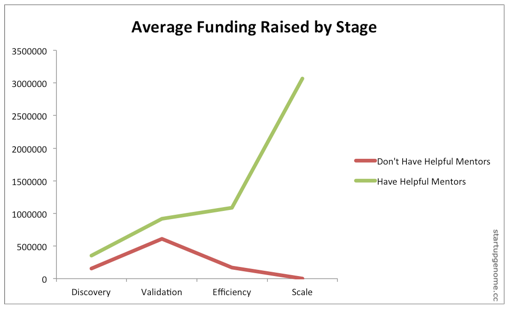
Surprisingly, the report found that beyond funding, mentors had very little effect on the success of startups. The team believes that this is because the good entrepreneurs who lack mentors to, for example, give them introductions to useful contacts, will always find a way to do this themselves.
Pivot power
While a pivot may sometimes seem like a last resort measure for startups, one or two pivots may actually be something of a sweet spot. The report found that startups which pivot once or twice raise 2.5 times more money, have 3.6 times better user growth, and are 52% less likely to scale prematurely than startups which pivot more than two times or not at all.
It’s not about the money
As the chart below shows, money is rarely the chief motivation for tech entrepreneurs. Making an impact motivated 68% of the startups surveyed, gaining experience motivated 27% and money motivated just 5%.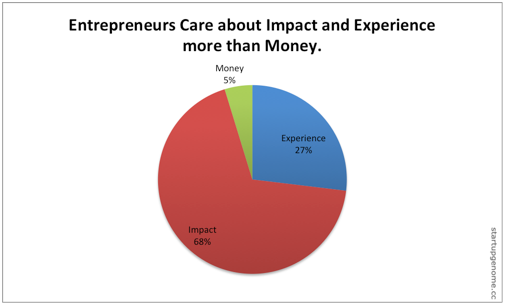
The future of the project
Today’s publication isn’t the end of the Startup Genome Project. A new survey for startups has just gone live, with the aim of gaining even more data to help delve deeper into the ‘genetic code’ of Internet startups. Not only that, it can help entrepreneurs understand the stage their startup is in and gives them personalized tips and advice for what to focus on based on data from the startup genome project. If you’re a tech entrepreneur and would like to take part, you can find more information here.
A self-assessment tool in the form of a Web app, designed to let startups work out exactly what type they are and what stage they’re currently at is also in the works.
The work that has gone into this report is enormous, and it will be interesting to see if startups and investors alike begin to refer to it as they make important decisions in the future.
Get the TNW newsletter
Get the most important tech news in your inbox each week.