
The Next Web

The World Wide Web that could’ve been, by Apple

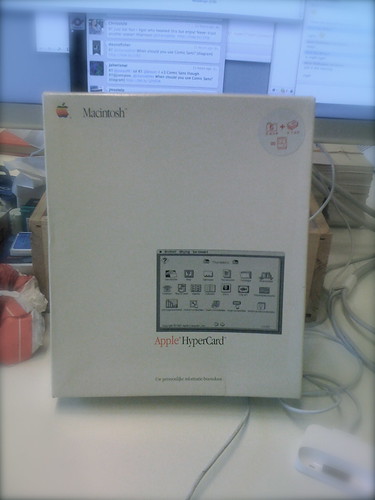
Apple HyperCardIn 1990 I bought my first Apple computer: the Macintosh Plus ED. People at school thought I was crazy for buying a computer with that much memory. The Macs at school had 1mb memory, mine had 2,5mb.

Within a few weeks I started working with HyperCard and got completely addicted to it. HyperCard was basically the World Wide Web without the “World Wide” part. You could build ‘Stacks’ with ‘Cards’ that could link to each other by linking images and text. The language running all of this was HyperText and developing stuff was as simple as typing “go to card 3″.

People used HyperCard to build inventory systems, libraries and all sorts of applications that were shared using floppies. I used it at first to make animations and later I programmed my first applications that made semi-random drawings.

This morning, on my way to work, I noticed a bunch of books next to a trashcan. One of the books was the Apple HyperCard handbook. I just couldn’t leave it there.

Looking back I realize that HyperCard had a huge influence on the rest of my career. It gently introduced me to developing and the inner workings of applications and, later, websites.

If HyperCard would have stayed around a little bit longer I wonder how it would have affected the World Wide Web. It seems like such a logical step to make it Internet based, in hindsight.

So, what was the first language you started developing in?
Did you use HyperCard and HyperText too?
What did you built?

Let me know in the comments….


  • jay
    Ward Cunningham, the developer of the first wiki software was apparently inspired by HyperCard

    http://en.wikipedia.org/wiki/Wiki
  • I don't remember programming in HyperCard, but I do remember making Stacks.

    I also remember that the decision by Apple to kill of HyperCard cause an uproar at the time.
  • DBase III Plus (if you don't count MS-DOS batchfiles as a 'programming language')
  • Prullenbak
    I believe I started making websites when I was around 13 ('97). Shortly after that, I had a school assignment to make some stuff in Visual Basic, but I hated it and didn't continue. I kept making websites in HTML and a little javascript and a couple of years later I learned some ActionScript. In the years after that, in chronological order, I learned: Java, a tiny little bit of C++, CSS, and some PHP.

    I don't remember much of it all, though. Only the web-stuff :)
  • Rob Griffiths
    I started with Basic on a Commodore plus 4 and then a Commodore 64.

    Okay so most was a copy and type out affair but it led me onto batch files, VB, and then HTML and PHP.

    Humble beginings.
  • I started programming with QBasic on a 80286 PC then switching over to Assembler after about a year or so. In 1997 i got in touch with the internet for the first time. That was amazing and i got addicted very quick. I haven't used a Macintosh or any other Apple device until 2005 but that particular friday in Februrary 2005 changed my live.

    Now I'm into web development as well as Cocoa development on both Mac and iPhone.
  • I started with QBASIC. Did a bit of VB before going web with HTML and PHP. Quickly ditched table-based layouts in favour of CSS and have never looked back. Now I'm dabbling in C# (.Net), C, Java and Javascript...
  • Ooh yes that reminds me. Have done a bit of ActionScript too.
  • Yeah, some C++ was my start, then a lil' PHP. Still can't code tho, just reading.
  • Thom
    I have been using Macs since 1984 and got my own in the early 90's. It was a lot of money then. I never even looked into HyperCard. Wish I had. I started with Pascal.
  • Nick Sharratt
    I experenced HyperCard on the Macs at uni - I even wrote a small essay about it which included reference to the concept of being 'lost in hypertext' when you lose track of your context...a concept familiar to everyone now from the web I bet :)

    first programed in BASIC on a Commador Pet (8K, 40x25 green screen - still wrote some 'good' games on it). Progressed to 6502 assembly language slightly, then ZX81 basic and a little Z80 assembler, only really learned 'good' programing on BBC model B with it's much better BASiC and built in assembler, although I then learned all over again in Pascal at Uni, then all over again with object oriented approach with Turbo pascal, then learned yet again with DBase iV, and then SQL in MS Access...and somewhere in there I was blown away by Prologue and baffled by Lisp, dabbled with C (writing for X11 on Sun sparcs)...

    Every new language/platform opened whole new vistas of opportunities and their own issues, and although the PET was first, each one after was a 'first' too.
  • Twinkle Toes
    Sssst...don't tell anyone. I used floppy disks too. Don't tell anyone, they will think I am old, like Boris.

    The first language I used? Hmm...I think it was Pascal.
  • The name of HyperCards programing language was HyperTalk.

    And yes, I started with HyperCard too. Even today there's nothing the pulls you so gently into the programming and database world.
  • Hypercard was also my first dev tool. I was about 13 or 14 and started digitizing our school's library books with one of the first hand-held scanners and OCR programs. Then I used Hypercard to create an index and display them. It was more like a proof of concept project, but very fun at the time.
  • There's actually an implementation of this which is still used in modern systems.

    When developing wap-applications for cellphones you still use cards and stacks in some cases to cover specific brands.

    :)
  • I started programming writing verbs on MOO's. ;-)
  • The programming language RevTalk from RunRev (www.runrev.com) was inspired by Hypercard. Has a growing user base of avid HyperCard fans. You'll recognize the similarities.
blog comments powered by Disqus


TwitterCounter